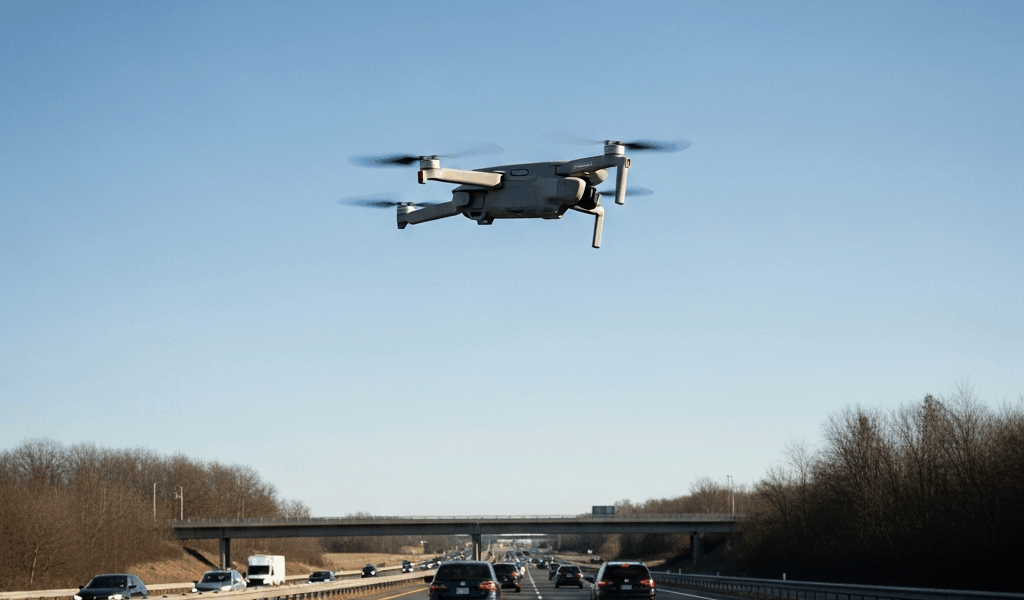
What the FAA Actually Says About Drones Over Vehicles
Flying drones over traffic has gotten complicated with all the conflicting information flying around. As someone who spent months chasing waivers and digging through FAA documentation, I learned everything there is to know about this specific gray zone. Today, I will share it all with you.
So, without further ado, let’s dive in.
The FAA’s rules on flying over moving cars are nowhere near as black-and-white as the rules on flying over people. That distinction matters — a lot, actually.
Recreational flyers operate under a fairly simple baseline: don’t fly over moving vehicles in any way that creates a safety hazard. The Community Based Safety Guidelines — published by the Academy of Model Aeronautics — recommend against sustained flight directly over roadways where traffic moves unpredictably. That’s the whole rule. Interpret it carefully.
Part 107 commercial pilots face tighter constraints. Flying over moving vehicles requires either an FAA waiver or operation under specific Categories that permit it. Most standard Part 107 authorizations do not include blanket permission to fly over highways or moving traffic. You need explicit approval. Full stop.
Here’s what trips people up: vehicles aren’t treated the same as people in the regulations. A moving car isn’t covered by the same “no flying over moving people” restriction you find in recreational rules. But that’s not a free pass. The FAA still requires safe, responsible operation — and that judgment call lands entirely on you.
Does the Mini 4 Pro Weight Exemption Help Here
Probably should have opened with this section, honestly.
The DJI Mini 4 Pro weighs 249 grams. That sub-250-gram threshold gets you real benefits — but I made the mistake early on of assuming it meant I could fly nearly anywhere without restriction. Don’t make my mistake.
The weight exemption helps in three specific ways. No FAA registration required for recreational flyers. Access to some restricted airspace where heavier drones can’t go. Exemption from certain operational restrictions — though the Mini 4 Pro still requires visual line of sight under standard recreational rules.
But flying over moving vehicles? That exemption does almost nothing for you.
The FAA’s safety concerns over roadways aren’t weight-dependent. A 249-gram drone falling into traffic or startling a driver into swerving — that’s a hazard regardless of grams. The Mini 4 Pro’s light weight actually creates a different problem: distance and altitude become genuinely easy to misjudge, especially over pavement that throws back glare in harsh light.
I’m apparently bad at eyeballing altitude over reflective surfaces, and the Mini 4 Pro works for me in most conditions while direct-overhead highway shots never do. Recreational flyers still need to follow community guidelines. Part 107 pilots still need a waiver or Category authorization. The sub-250-gram designation sits somewhere between recreational freedom and commercial restriction — but it doesn’t unlock legal flight over moving traffic. Not without additional permissions.
Recreational vs Part 107 Flying Over Traffic
Recreational Flying Over Moving Vehicles
- Follow Academy of Model Aeronautics (AMA) Community Based Safety Guidelines — they specifically advise against sustained flight over roadways with active traffic
- Brief, incidental road crossings are generally acceptable if you maintain altitude and keep the drone clear of vehicle paths
- Hovering or orbiting directly above moving traffic is a hard no, under any circumstances
- No formal waiver required, but local ordinances matter here — some cities have explicit drone restrictions tied to roadways specifically
- Log your decision-making process if anything goes sideways; timestamps and notes show due diligence and can save you later
Part 107 Commercial Flying Over Moving Vehicles
- Standard Part 107 certificate does not include authorization to fly over moving vehicles on roadways or highways
- You need either a specific waiver — FAA Form 7711-1 — or operation under an approved Category that explicitly permits vehicle overflight
- Waivers for this purpose typically take 4–8 weeks to process through the FAA’s DroneZone portal
- Approved waivers almost always carry conditions attached: minimum altitude, buffer zones, required spotters, documented flight plans
- Category A through D approvals under the new airspace integration structure do not automatically include vehicle overflight permissions — you must request it explicitly, every time
Real Scenarios and How to Handle Each One
Brief Crossing of a Two-Lane Road
Scenario: You’re filming property near a quiet rural road. To get the shot, your Mini 4 Pro crosses the road at 200 feet altitude for about 5 seconds.
Answer: Probably legal for recreational flyers. The key factors here — incidental crossing, low traffic volume, no hovering. Do this regularly or during peak hours and it reclassifies as sustained flight. Reconsider at that point.
Filming a Highway from the Side
Scenario: You want cinematic shots of a highway with traffic moving through frame, but the drone stays 300 feet to the side of the road — never directly overhead.
Answer: Legal for both recreational and Part 107 pilots. You’re filming vehicles, not flying over them. Straightforward situation. No additional restrictions triggered.
Shooting a Parking Lot with Active Traffic
Scenario: Commercial real estate shoot. The lot has cars moving around, and you want aerial footage of the property and its surroundings.
Answer: Maybe — and it genuinely depends on vehicle speed and predictability. For a tight, slow-moving lot, Part 107 pilots can often operate under standard authorization if safe distance and control are maintainable. Recreational flyers should avoid hovering near active traffic. Period.
Road-Trip Documentary Footage Over Multi-Lane Highway
Scenario: Commercial production. Sustained overhead shots of vehicles on an interstate. The whole thing.
Answer: No — not without a waiver. Get the Part 107 waiver. Budget six weeks minimum and include a detailed flight plan covering buffer zones and spotter positions. It’s the only legal path here.
How to Stay Legal Without Killing Your Shot
Frustrated by rules that seem to work directly against your creative vision? I was too. Then I started thinking differently about angles.
Shoot from the side of roadways instead of directly overhead. The Mini 4 Pro’s 4K sensor — running on a 1/1.3-inch CMOS — pulls surprising detail from real distances. You get motion, traffic context, depth. Zero regulatory headache. Most viewers honestly can’t distinguish a 45-degree angle shot from a direct overhead one anyway. That’s what makes lateral composition endearing to us drone operators — it solves two problems at once.
Use natural traffic breaks. Early mornings, midday on weekdays, off-peak windows. Scout the location first — go once without flying. Pick a shoot time when traffic is minimal, even if that means rescheduling a client call. Worth it.
Check local ordinances before building your shot list. City and county drone restrictions sometimes exceed FAA rules by a wide margin. Call your city planning department or parks office. Takes maybe 10 minutes. Saves significant regret.
For Part 107 pilots shooting commercially, the waiver process isn’t punishment — it’s documentation. Once you have FAA approval in hand, you have explicit written permission. Insurance carriers like that. Clients like that. You bid with real confidence instead of hoping nothing goes wrong.
Keep flight logs. Timestamp, location, duration, drone model, stated purpose. The Mini 4 Pro stores telemetry automatically — export it after every session, save it somewhere backed up, file it by date. If you ever need to demonstrate responsible operation, that data is your evidence.
Flying over moving vehicles with a Mini 4 Pro is manageable. Not impossible — just structured. Ask the right questions before launch. Respect the spaces where other people’s safety genuinely outweighs one shot.

Stay in the loop
Get the latest dronefaaregulations updates delivered to your inbox.