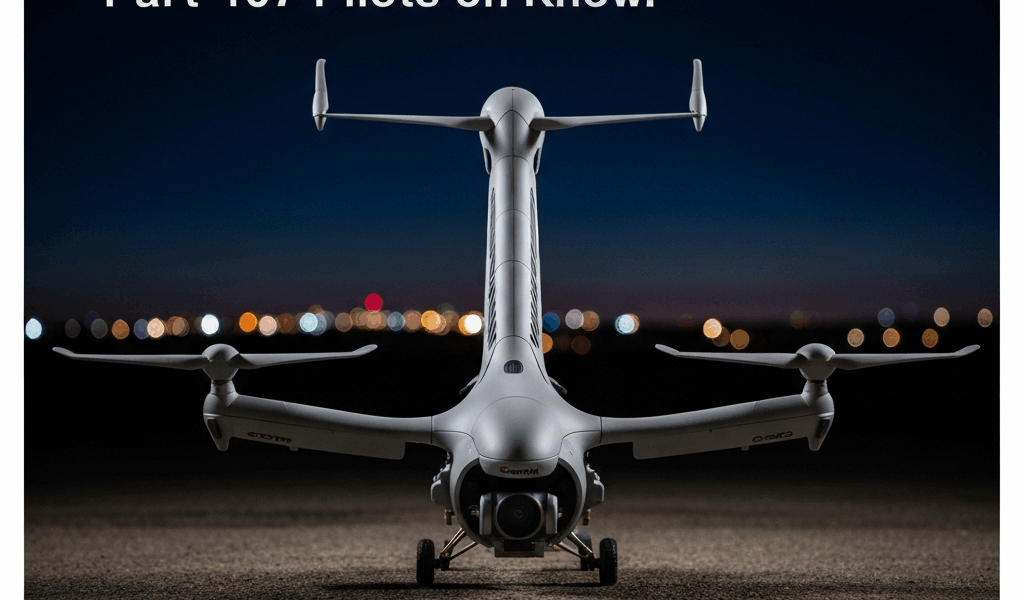
Drone Night Flying Rules 2026 — What Part 107 Pilots Need to Know
This article includes affiliate links. We may earn a commission at no extra cost to you.
Drone night flying has gotten complicated with all the outdated information flying around. I’ve held my Part 107 certificate since 2019, and in that time I’ve fielded the same question from newer commercial pilots more times than I can count: “Do I still need a waiver to fly at night?” The answer has been no since April 2021. But the rules that replaced the waiver system are specific — and getting them wrong can cost you your certificate, your wallet, or both. Here’s where everything actually stands heading into 2026.
Night Flying Without a Waiver — What Changed
Before April 21, 2021, night operations under Part 107 meant submitting a detailed safety case to the FAA, waiting weeks for a response, and hoping your specific operation fit whatever the agency was willing to approve. I went through that process once for a real estate shoot — spent probably eight hours on the application for a two-hour flight window. A single evening’s work. Not great.
The FAA’s Final Rule on Remote ID and Operations Over People ended that. Night flying moved out of waiver territory entirely and into standard Part 107 operations.
But what does that actually mean in plain terms? In essence, it’s a reclassification — night ops went from an exception requiring individual approval to a routine privilege for certificated pilots. But it’s much more than that, because the FAA attached specific equipment requirements that have real enforcement teeth.
- Night operations are now a standard Part 107 privilege, not an exception requiring individual FAA approval
- Civil twilight — 30 minutes before official sunrise or 30 minutes after official sunset — falls under the same night rules as full darkness
- All other Part 107 provisions still apply: airspace authorization, visual line of sight, the works
- The waiver elimination applied only to certificated Part 107 pilots, not recreational fliers operating under Section 44809
That’s what makes the 2021 rule change endearing to us commercial operators — it finally treated night flying as the manageable, routine operation it actually is when you have the right equipment. But the FAA didn’t just open the door and leave. They left one very specific condition attached to the handle.
Anti-Collision Light Requirements
Probably should have opened with this section, honestly. The waiver elimination is the headline everyone remembers. The lighting requirement is where pilots actually get into trouble.
Under 14 CFR § 107.29, any drone operating at night or during civil twilight must carry an anti-collision light visible for at least 3 statute miles. That light must be on and operating for the entire flight — not just during takeoff, not just near obstacles. The whole time. From wheels-up to touchdown.
What Counts as Compliant Lighting
The FAA doesn’t mandate a specific flash pattern, color, or mounting position beyond that 3-mile visibility threshold. In practice, most operators run a strobing white or red light. Steady lights — even bright ones — generally don’t serve the anti-collision purpose the way a strobe does. A flashing light against a dark sky is dramatically more detectable than a constant glow.
A few options I’ve tested personally on actual commercial flights:
- Lume Cube Strobe (LC-STROBE1) — Claims visibility beyond 3 miles, weighs 16 grams. I’ve run it on a DJI Mini 3 Pro without any meaningful payload issue on calm nights.
- UAVLENS Anti-Collision Strobe Light — More common on heavier platforms. 360-degree visibility, rated to 3-plus miles. Mounts cleanly on most landing gear.
- DJI Mavic 3 Enterprise built-in beacon — The Enterprise series ships with a top-mounted beacon that meets the 3-mile standard. The standard consumer Mavic 3 does not include this.
That last distinction matters more than most people realize. Consumer DJI drones — a Mini 4 Pro, a standard Mavic 3, an Air 3 — have built-in navigation lights designed for pilot orientation awareness. They are not anti-collision lights under the FAA definition. They don’t meet the 3-statute-mile requirement. You need to add a compliant strobe before any legal night operation. Don’t make my mistake — I assumed the factory lights were sufficient for my first post-waiver night shoot. They weren’t, and
I found out in the worst possible way: mid-debrief with a client who’d watched me unknowingly operate outside legal requirements.
2026 Considerations for Anti-Collision Lighting
No new lighting standard took effect at the start of 2026 — the 3-statute-mile rule is unchanged from the 2021 Final Rule. What has shifted is enforcement activity. The FAA has been more aggressive in certificate action cases tied to night operations, and “failure to display anti-collision lighting” is the most commonly cited violation. That’s not a warning-letter situation — civil penalties for commercial operators can reach $27,500 per violation.
Document your lighting setup. Before every night flight, I photograph the strobe mounted on the aircraft as part of my standard pre-flight checklist. Takes four seconds. Has already saved me one uncomfortable conversation with local law enforcement who pulled up assuming I was flying illegally.
Updated Training Requirement
Struck by how many pilots I’d talked to who had no idea the knowledge requirements changed alongside the operational rules, I started asking directly at drone club meetups. Most people knew the waiver was gone. Far fewer knew night operations had become an explicit topic in both the initial knowledge test and recurrent training. Apparently the FAA’s communication on that piece was quieter than the waiver announcement.
Here’s where it stands for 2026:
Initial Knowledge Test
The Part 107 Aeronautical Knowledge Test — administered at PSI testing centers, currently $175 per attempt — covers night operations as a standalone subject area. Expect questions on:
- Anti-collision lighting requirements and the 3-statute-mile visibility minimum
- Human factors specific to night vision — how the eye adapts to darkness and why direct fixation on your aircraft actually works against you
- FAA’s definition of night, including civil twilight boundaries
- Visual line of sight limitations when visibility is reduced after dark
Recurrent Training — WINGS and the Online Course Option
Part 107 certificates don’t expire, but pilots must complete recurrent training every 24 months to stay current. The FAA’s free online recurrent training course — available at faasafety.gov — includes a dedicated night operations module added as part of the 2021 rule update. It’s not optional background reading. Knowledge check questions are built in, and you can’t skip past them.
The physiological content in that module is genuinely worth your attention. The human eye’s rod receptors — responsible for low-light vision — are concentrated around the retina’s periphery, not the center. Looking slightly off to the side of your aircraft in dark conditions gives you better visual acuity than staring directly at it. That’s not intuitive. It’s also operationally important when you’re trying to track a small UAV against a black sky at 300 feet.
Operational Best Practices After Dark
Rules tell you the minimum. This section covers what actually makes night operations go smoothly — drawn from several years of commercial night work across real estate, construction site documentation, and outdoor event coverage.
Use a Visual Observer — Seriously
Part 107 allows but doesn’t require a visual observer during standard operations. At night, a VO stops being a nice-to-have. Your attention is split between the controller screen, the aircraft lights in the sky, and airspace awareness — simultaneously, in the dark. A dedicated observer watching the aircraft and calling out conflicts gives you back real cognitive bandwidth at exactly the moment you need it most.
Brief your VO before every flight. Give them a specific job: track the aircraft lights, scan for manned aircraft approaching the area, call out any movement on the ground below the flight path. A VO without a defined role isn’t much help — they end up watching whatever catches their eye rather than what actually matters.
Altitude Awareness Without Visual Reference
This is where I made my worst early mistake in night flying — relying on the aircraft’s onboard altitude reading without cross-referencing it against known obstacle heights in the operating area. At 200 feet AGL in daylight, you can see the 150-foot cell tower a quarter mile away. At night, that same tower is a blinking red light at roughly your altitude, or it’s nothing at all if the lighting has failed.
Before any night flight, I pull up a sectional chart and map every obstacle within half a mile of my planned operating area. I log the maximum obstacle height — the actual number, written down — and set my operating ceiling 50 feet below it whenever I’m working unfamiliar terrain.
Pre-Flight Checklist Items Specific to Night Operations
- Verify the anti-collision strobe is mounted, powered, and actively strobing before takeoff — not just switched on, actually flashing
- Confirm all orientation lights are functioning so you can maintain attitude awareness through the flight
- Check battery temperature — cold night air degrades lithium battery performance more than most pilots budget for. I add a 15-percent buffer to estimated flight time in temperatures below 50°F
- Identify a visual horizon reference before launch — a lit building, a strip of road lights, anything that helps you maintain spatial orientation if your attention drifts off the aircraft
- Run a NOTAM check with specific attention to temporary flight restrictions that may not have been active during earlier daytime planning
Obstacle Avoidance Sensors at Night
Most consumer drones with obstacle avoidance — the DJI Mini 4 Pro, the Air 3, the Avata 2 — use optical sensors that don’t function in low-light conditions. The system you rely on during the day is likely disabled at night. Even the DJI Mavic 3 Pro, which uses both optical and APAS systems, carries a manufacturer note that obstacle avoidance performance is degraded in darkness. Fly conservatively after dark. Slower speeds, wider margins, more deliberate movement around anything you haven’t personally confirmed is clear. Assume the automation won’t catch what you miss.
Night flying under Part 107 is genuinely accessible now — cleaner than it ever was during the waiver era. Know your lighting requirement cold, stay current on recurrent training, and build pre-flight habits that account honestly for what darkness takes away from you. The rules are reasonable. Following them carefully is what keeps the airspace working for everyone using it.


Stay in the loop
Get the latest dronefaaregulations updates delivered to your inbox.