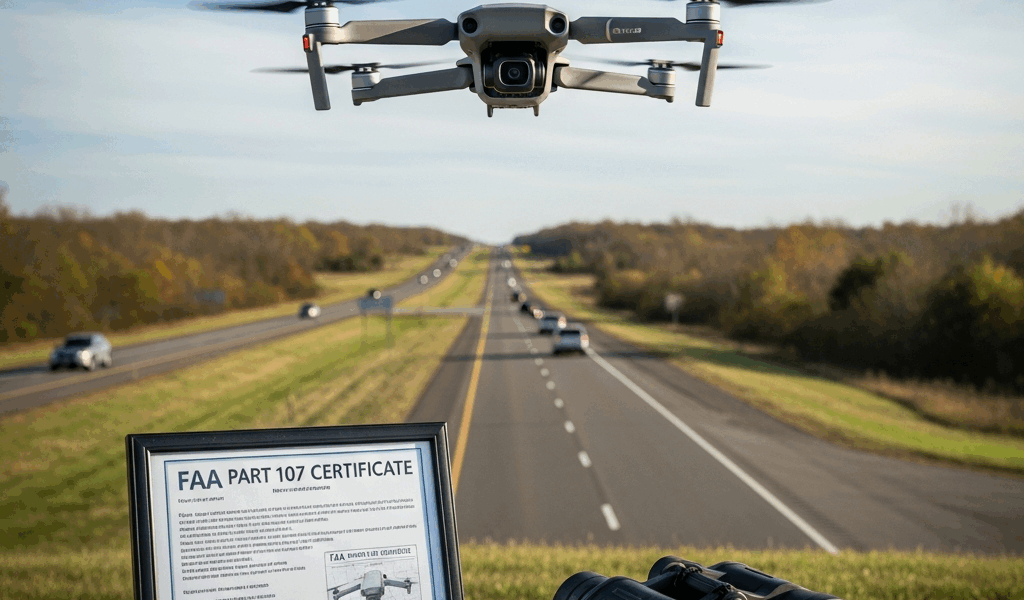
Can You Legally Fly the Mini 4 Pro Over Roads—
Flying drones near roads has gotten complicated with all the misinformation flying around. Some sites tell you never to do it. Others just skip the question entirely. Neither is helpful. So here’s the real answer: the FAA doesn’t ban flying over roads. What they actually prohibit is flying over moving vehicles on public roads without a waiver. That’s a genuinely important distinction most people miss.
An empty county road at 6am on a Tuesday? Probably fine. A four-lane highway during rush hour? That’s a federal headache without the right paperwork. As someone who has spent two years flying the Mini 4 Pro under Part 107 across five states, I learned everything there is to know about this subject — including what happens when you push the boundaries wrong. I filed two waiver requests for moving vehicle operations. Both got denied. Today, I will share it all with you.
Recreational pilots have it stricter, by the way. Under the FAA Reauthorization Act rules, you simply cannot fly over moving vehicles on public roads. No waiver option. No sub-250g exception. Part 107 holders get a narrow waiver pathway — but approval is genuinely rare.
What the FAA Actually Says About Flying Over Vehicles—
But what is Part 107.145? In essence, it’s the regulation that says Part 107 pilots cannot operate over anyone not directly participating in the flight — unless that person is inside a structure or stationary vehicle providing reasonable protection. But it’s much more than that. Every driver and passenger on a public road technically becomes a “non-participating person” the moment your drone passes overhead.
Flying 400 feet above a highway doesn’t make those cars disappear from a liability standpoint. You’re still betting on driver behavior, road conditions, and reflexes you can’t control. The FAA finds that unacceptable without prior written approval.
Here’s where the controlled-versus-uncontrolled ground area distinction actually changes things. A closed movie set — private road, hired drivers, safety perimeter, everyone participating under direction — that’s controlled. A waiver there is at least plausible. Grantable, even. Flying over that same stretch of road on an ordinary Thursday afternoon with normal traffic? Uncontrolled. The waiver gets rejected roughly 90% of the time, if anyone even files one.
Frustrated by my own rejected waiver for a residential street flyover during morning commute hours, I called the FAA’s UAS hotline directly. The inspector I spoke with was blunt: public roads introduce too many uncontrollable variables. Driver attention. Weather shifts. Communication failures mid-flight. Even coordinated environments make them nervous. Open public traffic makes approval essentially impossible.
The workaround that actually works — and I use this constantly — is repositioning. Shoot from the roadside. Elevate the drone so the street appears in the lower third of frame without you hovering directly above it. The road reads as context, not target. That’s compliant. That delivers the visual. That’s what makes lateral offset so endearing to us road-adjacent drone operators.
How the Mini 4 Pro Weight Affects Your Road Flying Rules—
The 249-gram figure generates a lot of mythology. People assume sub-250g drones play by different safety rules. I’m apparently among the minority who actually read Part 107.145 carefully, and here’s what I found: weight exempts you from registration requirements and airworthiness certificates. It does not exempt you from restrictions on flying over people and moving vehicles. That myth has gotten people cited.
Remote ID is mandatory regardless. Real-time broadcast of aircraft location and operator position — required whether you’re Part 107 or recreational, whatever your drone weighs. The Mini 4 Pro handles this natively, or you can add hardware like the DJI RC Remote ID Module, which runs $399 and clips on without drama.
What the 249g weight does legitimately give you: slightly expanded flexibility in certain restricted airspace categories, and meaningfully lower insurance costs. Commercial drone insurance for the Mini 4 Pro typically runs $60 to $120 annually. Don’t make my mistake and skip it near roads. That’s cheap enough to be non-negotiable.
Local jurisdictions pile their own rules on top of federal ones — and they don’t always align neatly. Some counties prohibit drones within 500 feet of state highways. Others require commercial flight permits regardless of aircraft weight. Texas, California, and Florida each have their own road-related drone restrictions that differ from one another. Check your county and state aviation authority before you ever push the throttle up.
Step by Step How to Fly Over a Road Without Violating Rules—
- Check airspace using B4UFLY or Aloft. Enter your exact launch coordinates and confirm you’re outside Class B, C, D, or E airspace. Class G uncontrolled airspace is where the Mini 4 Pro operates most freely — at least if you want to avoid authorization headaches.
- Confirm no TFRs. Temporary Flight Restrictions appear fast — wildfires, VIP movement, emergency response. Check the FAA TFR map no more than 30 minutes before your planned launch. That was a lesson from a scorched August afternoon in Arizona I’d rather not repeat.
- Assess vehicle presence honestly. Will moving vehicles be on or near that road during your flight window? If yes, you need Part 107 certification and almost certainly a waiver. If no, you’re operationally closer to compliant — but verify with an actual site visit at the exact time you plan to fly. Maps don’t show Saturday farmers markets.
- Know your certification status cold. Part 107 or recreational-only? This single factor changes every option available to you. Recreational flyers have no legal path over moving public vehicles. None.
- Check local ordinances directly. Call your county recorder’s office or city planning department. Ask specifically about drone operations near public roads and state highways. Email works too — just get it in writing.
- Use lateral offset positioning. Don’t fly directly above the roadway when vehicles are present. Maintain 100 feet or more of horizontal clearance. This often eliminates waiver requirements in genuinely marginal situations while keeping your footage usable.
- Hold at 200 feet AGL. That altitude gives you visual margin and orientation clarity. Climbing above 300 feet for road shots burns battery, risks losing the aircraft visually, and adds no meaningful legal protection. It just looks cool on paper.
When You Need a Waiver and How to Get One—
Probably should have opened with this section, honestly. If you hold Part 107 and genuinely need to overfly moving vehicles on a public road for commercial work, the FAA waiver process lives at DroneZone — faadronezone.faa.gov. You submit an operation plan, flight data, safety protocols, and written justification. Budget 90 days minimum for review. Approval is not a given. Not even close.
For moving vehicle operations specifically, expect rejection unless you bring extraordinary safety documentation. Closed roads. Professional traffic control. Multiple trained spotters. Redundant communication systems. Even stacked that way, success is uncommon. I speak from experience — twice over.
The practical alternative most pros use: reframe the shot entirely. A real estate video of a house on a busy street doesn’t require hovering above the traffic lane. Shoot from the front yard at 45 degrees. The road reads in context. The viewer gets the location. Nobody files a waiver. So, without further ado — stop trying to solve this with paperwork and start solving it with composition.
Highway infrastructure projects, overpass inspections, active traffic monitoring — those legitimately need the waiver, and they need professional liability insurance running $1,500 to $5,000 annually for high-risk commercial work. That’s not a budget line to negotiate. That’s the cost of operating legally in that category.
Your takeaway for today: Fly the Mini 4 Pro freely over empty roads. Over moving public traffic, get Part 107 certified first, verify your airspace, and accept that waivers rarely come through. Reposition your shots to include the road without crossing above vehicles. Stay compliant, stay in the air, stay out of federal correspondence you didn’t invite.


Stay in the loop
Get the latest dronefaaregulations updates delivered to your inbox.