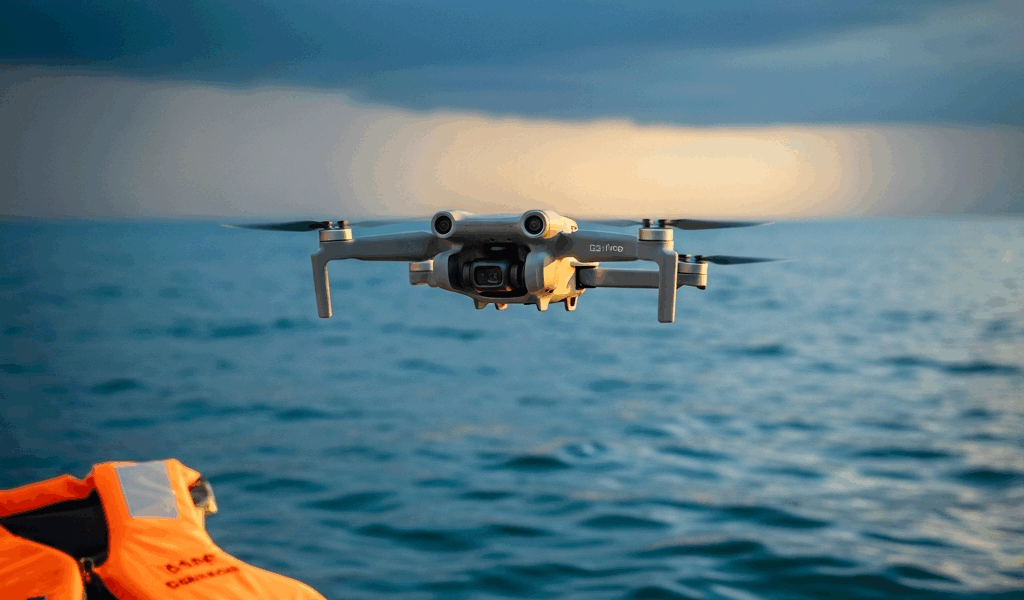
Is It Legal to Fly Your Mini 4 Pro Over Water
Flying a drone over water has gotten complicated with all the misinformation flying around. As someone who has logged dozens of coastal and lake flights with the Mini 4 Pro, I learned everything there is to know about the rules, the risks, and the recovery scenarios nobody talks about. Today, I will share it all with you.
The FAA doesn’t outright ban water flying. Not for recreational pilots, not for Part 107 operators. That’s the baseline. But legality isn’t a clean yes-or-no — it never is with airspace. Your location determines everything. The same county can have one lake that’s totally open and another that’s locked down tight by municipal ordinance or wildlife protection status. Two miles of distance, completely different rulebook.
Controlled airspace near busy airports, national parks, wildlife refuges — all of these can restrict or flat-out prohibit water flights. If you’re planning to fly near a waterway sitting inside Class D or Class C airspace — think within five to ten miles of a major airport or seaplane base — you’ll need LAANC authorization first. That’s Low Altitude Authorization and Notification Capability, a system that processes airspace access requests electronically, usually within seconds. I got denied once near a coastal airport outside Charleston, South Carolina. Get denied once and you understand why the step matters.
Before any water flight, pull up the B4UFLY app or check FAA DroneZone directly. Both show real-time airspace restrictions mapped to your exact GPS location. Takes five minutes, honestly. Sometimes thirty seconds. It saves genuine headaches — and potentially a federal fine.
So, without further ado, let’s dive in.
Where You Cannot Fly Over Water No Matter What
Certain waterways are hard stops. Certification level doesn’t matter. Good intentions don’t matter.
- National Wildlife Refuges — The U.S. Fish and Wildlife Service manages thousands of refuges built around wetlands, marshes, and coastal zones. Drone flights over refuge waters are prohibited in almost every case. The rule exists to protect nesting birds during sensitive breeding seasons. Check the specific refuge’s website before you pack anything into the car.
- National Park Waterways — If it’s a national park, assume the water is off-limits. Yosemite, Yellowstone, the Grand Canyon — all prohibit drones over park waters. Some parks ban drones entirely within their boundaries regardless of altitude. State parks vary wildly, so individual verification is non-negotiable.
- Marine Protected Areas — Coastal states like California, Florida, and Hawaii designate marine protected zones where drone activity is either prohibited or heavily restricted. These don’t always show up on standard navigation maps. Local knowledge helps, but the official state fish and wildlife agency websites are where you confirm specifics.
- Active Military Ranges and Training Areas — Coastal military installations, naval air stations, and weapons ranges near water are absolute no-fly zones. Flying near these areas isn’t just a fine situation — it triggers immediate federal response. Don’t test this one.
Real example. Lake Mayer near a Air Force base in Colorado looks pristine and open from the parking lot. Pilots have been intercepted there. The restricted zone extends well beyond the base perimeter and covers the entire lake surface.
Another one — the Salton Sea on the California-Arizona border carries complex restrictions tied to wildlife protection and overlapping airspace conflicts. Looks like open water from satellite view. It’s not.
Use B4UFLY or DroneZone before loading your gear. Thirty seconds. Real consequences on the other side of skipping it.
What Happens If Your Mini 4 Pro Goes Down Over Water
Probably should have opened with this section, honestly. Most water-flying articles skip the actual failure scenario entirely — which is wild, because it’s the one thing that actually costs people money.
The DJI Mini 4 Pro has zero official waterproofing. It carries an IP45 dust resistance rating only. Light rain? Survivable sometimes. Submersion? It sinks. Battery weight pulls it down faster than most pilots expect the first time they watch it happen.
Never attempt an intentional water landing. That’s the core rule. Some pilots assume they can glide the drone down gently onto a lake surface to preserve the hardware — that doesn’t work. The moment water contacts the internal components, the battery shorts and the props stop. It drops like a stone after that.
If your Mini 4 Pro goes down, recovery depends entirely on depth and proximity to shore. Shallow water within wading distance — maybe you get it back with a net or by walking in. Anything deeper than three feet, you’re probably not recovering it without a dive operation, which costs more than buying a replacement unit outright. Don’t make my mistake of flying too far over a reservoir assuming RTH would cover everything.
Third-party flotation accessories do exist. Buoyant landing gear kits and foam float attachments run roughly $30 to $60 from brands like Lume Cube and a handful of smaller manufacturers on Amazon. They add approximately 15 grams and buy you maybe 30 to 60 seconds of surface flotation — enough to recover from a ditch near shore, not enough for deep open water. Useful for shallow pond work specifically.
I’m apparently the type who reads insurance policy language before buying, and DJI Care Refresh works for me while standard homeowner riders never actually cover drone losses. My current policy runs $200 annually and covers water damage up to 10 feet depth — but excludes intentional water landings specifically. Read the clause language. Allianz and third-party options like Verifly have their own exclusion structures. Some cut off water damage entirely. Know what you have before you rely on it.
Best Practices for Flying Over Water Safely
Wind behaves differently over open water than over land. No trees, no buildings, no terrain to create friction — so wind speed climbs at water level. That calm breeze you felt on shore becomes a stiff headwind fifty meters out. Check the Mini 4 Pro’s wind-speed readout before committing to a flight — it lives inside the DJI Fly app under battery health diagnostics. Sustained wind above 20 mph is a delay situation. The Mini 4 Pro technically handles up to 28 mph, but water flying leaves no comfortable margin at that ceiling.
Keep the drone within retrievable distance of shore at all times. Meaning: if signal drops or battery fails right now, could you physically reach the landing zone on foot? Flying two miles out over open water breaks this rule completely. Stay within roughly a quarter mile of land you can actually access. That’s not a hard FAA rule — it’s a common-sense financial rule.
Set your Return to Home altitude above any obstacles sitting between your launch point and home. Water surfaces create reflective interference that confuses the Mini 4 Pro’s downward obstacle sensors. Set RTH to at least 150 feet when flying near shoreline trees or structures. Also — obstacle sensing disables entirely in Sport Mode and degrades in low light. Over water, use Cine Mode or standard flight mode. Keep the sensors active.
Avoid flying directly into sun glare bouncing off the water surface. The reflection generates a white-out effect on your FPV display and wrecks distance judgment fast. Fly with the sun behind you or to your side. Morning flights handle this better than afternoon sessions — that’s not preference, that’s just physics.
Enable all available obstacle avoidance features in the app settings before launch. The Mini 4 Pro senses objects forward and below in standard mode, but not behind. Flying backwards over water adds unnecessary risk with no real reward for most shots.
Remote ID and Registration Requirements Over Water
Remote ID rules apply regardless of terrain. Water operations aren’t exempt. If you’re flying under Part 107 commercial certification — or recreationally under the FAA’s current airspace framework — Remote ID compliance is mandatory. Full stop.
But what is Remote ID? In essence, it’s a broadcast system that transmits your drone’s identification and location data in real time to anyone with a receiver nearby. But it’s much more than that — it’s the FAA’s long-term framework for integrating drones into shared airspace, and enforcement is expanding.
The Mini 4 Pro weighs under 249 grams, which removes it from FAA weight-based registration requirements for recreational use specifically. If you’re flying commercially — meaning for any form of compensation or as part of business operations — registration is required. Register through FAA DroneZone. Five dollars, valid five years. The site handles Remote ID confirmation at the same time.
Recreational fliers carrying older registrations from before the 2023 Remote ID rule updates should verify their current status on DroneZone. The rules shifted. Check your account and confirm compliance before your next flight.
No carve-outs exist for water operations. That’s what makes Remote ID consistent across environments — the rules are identical whether you’re hovering over a parking lot or a 500-acre reservoir two miles from shore. Same requirements, same enforcement exposure.

Stay in the loop
Get the latest dronefaaregulations updates delivered to your inbox.