What the FAA Actually Requires for Night Drone Flights
Night drone flying has gotten complicated with all the misinformation flying around. As someone who flew into a regulatory nightmare at dusk over a marina in 2022, I learned everything there is to know about FAA night compliance the hard way. Today, I will share it all with you.
Before September 2021, recreational and Part 107 commercial pilots needed an explicit FAA waiver just to fly after sunset. The paperwork took weeks — sometimes six to eight weeks, honestly — and approval was never guaranteed. Then the FAA finalized Part 107 reforms that scrapped the night waiver requirement entirely. For both groups. Gone.
One condition replaced all of it.
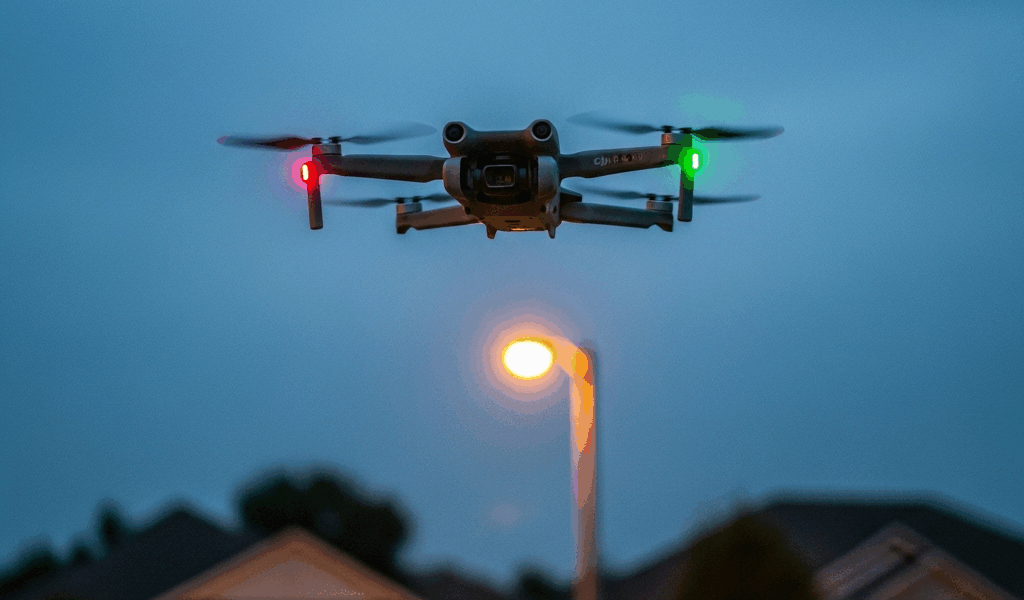
Anti-collision lighting. That’s it. Your drone must carry lights visible from at least three statute miles under clear nighttime conditions. Not two miles. Not “pretty visible from the parking lot.” Three statute miles. Steady or flashing both qualify, but the lights have to make your aircraft identifiable to manned operators and ground observers.
This standard holds whether you’re flying recreationally or under a Part 107 commercial certificate. Violating it runs up to $27,500 in fines for recreational pilots — higher for commercial operators. Probably should have opened with this section, honestly. The lighting requirement is the entire gatekeeping mechanism. No compliant lights, no legal night flight. Full stop.
Does the Mini 4 Pro Have FAA-Compliant Lighting Built In
Direct answer: no. The DJI Mini 4 Pro does not ship with factory anti-collision lights that meet the three-statute-mile visibility standard on their own.
But what is the Mini 4 Pro’s built-in lighting? In essence, it’s a set of four small LED indicators — one per arm, one on the chassis — that communicate battery status and arm state. But it’s much more than a status light. It’s a deliberate design choice rooted in weight engineering.
The Mini 4 Pro weighs 249 grams. One gram under the 250-gram threshold that triggers stricter FAA recreational regulations. Every single gram was a decision. Built-in strobes bright enough for three-statute-mile visibility would add weight, pull more battery current, and complicate the chassis geometry. DJI left night lighting to aftermarket manufacturers — which tells you third-party builders have already solved this problem, repeatedly and cheaply.
I’m apparently a “fly it til it breaks” type and the factory LEDs work fine for my indoor practice sessions, but outdoor night flying for compliance purposes? Never gonna cut it. Don’t make my mistake of assuming otherwise before your first dusk flight.
Anti-Collision Lights That Work With the Mini 4 Pro
While you won’t need anything exotic or expensive, you will need a handful of reliable options to choose from. Three aftermarket systems work consistently with the Mini 4 Pro’s form factor and weight budget.
Neewer Compact LED Strobe Kit — These mount to the landing gear legs using small rubber clips. Weight penalty runs about 8–12 grams for the pair. They draw power through a splitter cable off the main battery connector — a minor setup step, maybe five minutes the first time. Output clears the three-statute-mile standard. Cost sits around $25–$35 on Amazon. That was the price last I checked, anyway.
PgyTech Top Lighting System — A mounting bracket with integrated LED panels that replaces the standard gimbal protector, sitting on top of the aircraft. Slightly more visible in your frame but it delivers consistent brightness. Weighs approximately 14 grams. Price runs $40–$50. The real advantage here is clearance — it doesn’t crowd the side obstacle avoidance sensors, which matters more than people realize at night.
Sunnylife LED Anti-Collision Lights — These clip directly onto the motor arms. Lightest option of the three, adding only 6–8 grams total. They run off a small separate battery pack that tucks into the battery compartment area. Red and green coloring helps with aircraft orientation in the dark — genuinely useful when you’re trying to track the drone against a black sky. Cost typically falls between $20–$30.
That’s what makes the aftermarket strobe ecosystem endearing to us Mini 4 Pro pilots. Lightweight, cheap, removable in thirty seconds. The weight tradeoff deserves a real mention though: adding 8–15 grams to a 249-gram aircraft trims flight time by roughly 10–15 percent. Stock hover time around 31 minutes? Expect 26–28 minutes with strobes attached. For recreational night flying, usually fine. For extended commercial mapping work, plan your battery rotations accordingly.
Mini 4 Pro Camera and Obstacle Sensing Settings for Night
So, without further ado, let’s dive into optimizing the aircraft itself once your lighting is squared away.
Open the DJI Fly app and go to Camera Settings. Start with ISO. The Mini 4 Pro’s 1/1.3-inch CMOS sensor handles higher ISO values noticeably better than older drone cameras — you can push to ISO 1600–3200 without unacceptable noise. ISO 6400 is possible but grainy enough to frustrate most photographers. Shutter speed between 1/50 and 1/125 of a second balances exposure without introducing motion blur from wind or gimbal micro-drift. Adjust from there based on your specific conditions. Those numbers are starting points, not commandments.
Here’s where things get genuinely important. The Mini 4 Pro’s forward, downward, and sideways obstacle sensors use visual and infrared data. In darkness, that effectiveness drops substantially — detection range shrinks from the listed 20-plus meters down to roughly 3–5 meters in pitch-black conditions.
Navigate to Safety Settings in the app and find Obstacle Avoidance. DJI defaults this to “On” for recreational users. First, you should check that status — at least if you’re flying anywhere near structures, trees, or power lines after dark. Your two real choices: keep it on and accept the reduced detection range, or disable it and rely entirely on your own situational awareness. Most experienced night flyers I know disable obstacle avoidance and fly slower, keeping clear sight lines to the aircraft the entire time.
The app throws a warning when you disable it. That’s fine — the warning was written for daytime users flying fast. You’re operating deliberately, at night, with compliance lights running, in airspace you’ve already visually cleared. The warning doesn’t apply to you the same way.
Night Flying Mistakes That Get Drone Pilots in Trouble
Four compliance failures catch otherwise careful pilots. Frustratingly, most of them happen to people who actually read the rules.
Flying without the anti-collision light on. This is the primary violation — the light must be installed, powered, and functional before wheels-up. One flight after dark without it is a civil violation regardless of whether any enforcement agent saw it happen.
Assuming airspace authorization evaporates at night. It doesn’t. If you need LAANC clearance or a TFR waiver to fly an area during daylight, that requirement doesn’t disappear after sunset. Check your airspace before every launch — night operations don’t exempt you from Part 107.41 or the standard authorization process. I use the FAA DroneZone app, takes two minutes.
Treating the 249-gram weight threshold as approximate. Once your Mini 4 Pro plus mounted strobes exceeds 249 grams, you’ve crossed into a different regulatory category for recreational flyers. Weigh your full configuration on a kitchen scale before the first night flight — a decent postal scale runs about $12 at Walmart. If you’re over, you’ve changed your aircraft’s classification. That matters.
Flying beyond visual line of sight after dark. Still illegal for recreational pilots. Still requires explicit Part 107 authorization for commercial operators. Night conditions make BVLOS considerably riskier than daytime attempts — maintain visual contact with your drone at all times, period.
Before every night flight, run this in your head: anti-collision lights installed and powered, airspace checked and clear, obstacle avoidance settings confirmed, weight verified under 249 grams if flying recreationally, and a clear mental picture of your flight path. Five minutes of prep prevents months of regulatory headache. I do it sitting in my car before I even open the case. Takes less time than reading this paragraph.

Stay in the loop
Get the latest dronefaaregulations updates delivered to your inbox.