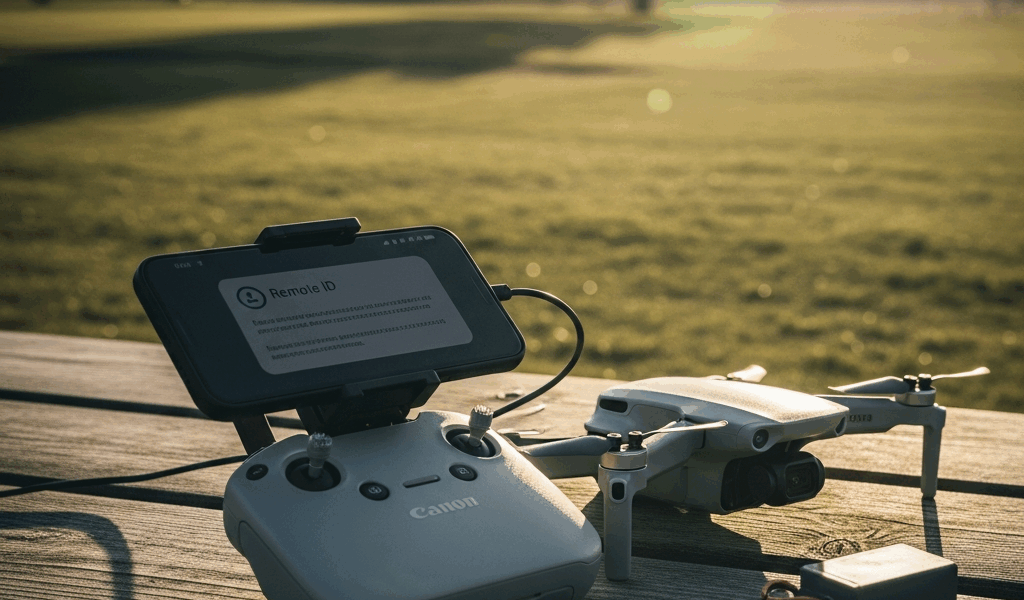
DJI Mini 4 Pro Remote ID — Battery Rules and Compliance Explained
DJI Mini 4 Pro Remote ID has gotten complicated with all the conflicting information flying around. I know because I learned everything there is to know about this subject the hard way — standing on a client’s property, standard Intelligent Flight Battery installed, no broadcast module, a real estate agent waiting on aerial footage, and the slow realization that I was technically non-compliant. The rules themselves aren’t hard. What trips people up is that the Mini 4 Pro’s Remote ID behavior actually shifts depending on which battery you’ve snapped in. That’s genuinely unusual in the drone world — and it catches people off guard constantly.
Let me break this down completely so you don’t end up in the same position.
Standard Battery vs Plus Battery — The Remote ID Switch
But what is the core issue here? In essence, it’s a weight problem. But it’s much more than that.
The Mini 4 Pro ships with two battery options: the standard Intelligent Flight Battery and the Intelligent Flight Battery Plus. They’re not interchangeable from a regulatory standpoint — even though both fit the same aircraft.
The standard battery weighs 80.5 grams. With it installed, the Mini 4 Pro lands at approximately 249 grams — just under the FAA’s critical 250-gram threshold. The Plus battery weighs 98 grams. That extra 17.5 grams pushes total aircraft weight to roughly 267 grams, which clears 250 grams and drops the drone into an entirely different regulatory category.
The FAA draws a hard line at 250 grams for recreational flyers. Under that number, recreational operators are exempt from FAA registration and — by extension — Remote ID broadcast requirements. At or above 250 grams, that exemption disappears.
DJI built Remote ID hardware directly into the Mini 4 Pro. Fly with the Plus battery installed — aircraft over 250 grams — and the drone broadcasts Remote ID automatically. Serial number, location, altitude, velocity — all of it going out simultaneously over Bluetooth and Wi-Fi, fully aligned with the FAA’s Broadcast Remote ID standard. Fly with the standard battery under 250 grams recreationally, and that broadcast stays silent. The hardware exists either way. It just doesn’t activate the same way depending on your configuration.
Probably should have opened with this section, honestly. This battery-weight relationship is the single most important thing to internalize before anything else.
Recreational vs Commercial — Different Rules Apply
The weight threshold governs recreational flying. Commercial flying is a separate framework entirely — and it doesn’t care about battery weight.
Flying recreationally means operating under the FAA’s Exception for Recreational Flyers, following community-based safety guidelines from an organization like AUVSI or AMA, in an approved location, purely for fun. Standard battery, under 250 grams, those three boxes checked? No registration required. No Remote ID required. You’re in the clear — and that’s a genuinely useful exemption. It’s a big part of why the Mini 4 Pro became so popular with hobbyists in the first place.
Commercial operation is different. Full stop. The moment you accept payment for footage, use drone imagery in a business context, or fly as part of any commercial enterprise, you’re under Part 107 — the FAA’s Small UAS Rule — which carries its own Remote ID requirements regardless of aircraft weight.
Under Part 107, every drone you fly must either have built-in Standard Remote ID capability, carry a compliant Remote ID broadcast module, or operate exclusively within an FAA-Recognized Identification Area (FRIA). There is no weight exemption. A 150-gram drone flown commercially still needs Remote ID compliance. Weight is irrelevant to Part 107 obligations.
This is where newer pilots get burned. They buy the Mini 4 Pro partly because of the sub-250-gram marketing, assume they’re exempt from Remote ID, then start doing paid work without realizing the recreational exemption no longer applies. Don’t make my mistake — I didn’t get the weight wrong, I misread which category my work fell into. Shooting photos for a friend’s business for free still counts as commercial under most interpretations. That one genuinely surprised me.
What If You Fly Commercial with the Standard Battery
So you’re a Part 107 pilot. You want to fly with the standard battery — maybe for extended range, maybe because that’s all you own, maybe because the Plus battery runs about $79 and it’s still sitting in your cart. You’re under 250 grams. You still need Remote ID. What now?
Two practical paths.
First, switch to the Plus battery. At 267 grams total, the drone’s built-in Remote ID kicks on automatically. No extra hardware, no bracket, no pairing process. You comply by default. The tradeoff is weight and modest wind resistance changes in gusty conditions — the Plus battery extends range slightly, but a heavier aircraft pushes back against the wind a bit more. For most commercial operators, this is the cleanest solution.
Second, attach a Remote ID broadcast module. The FAA allows external modules that meet the ASTM F3586-22 standard — DJI sells its own Remote ID module for approximately $39. It attaches to the drone’s body and broadcasts the required information independently of the aircraft’s built-in system. The Mini 4 Pro doesn’t have a dedicated module port, so you’ll need a mounting solution. Third-party brackets designed specifically for this setup — Badger Technologies makes a solid one for around $15 to $20 — are available and work well.
Frustrated by the lack of a clean mounting option on early units, plenty of operators ended up using adhesive mounts or 3D-printed brackets before purpose-built solutions arrived on the market. If you go this route, watch your total weight and balance — the Mini 4 Pro’s gimbal can be sensitive to forward weight shifts, and a poorly positioned module will make itself known.
There’s a third option — FRIAs — but these are FAA-designated areas, typically tied to flying clubs, where Remote ID isn’t required. Not practical for commercial operators who need to fly at client locations.
Firmware Updates That Changed the Rules
This section matters more than most people realize. DJI firmware version v01.00.03.00 changed how Remote ID behaved on the Mini 4 Pro in a meaningful way. If you bought your drone before this update rolled out, your unit may have worked differently than it does now — and not in your favor.
Before that firmware version, Remote ID broadcast behavior was inconsistent in certain edge cases, particularly around activation timing and how the aircraft reported operator location. The v01.00.03.00 update standardized the broadcast to fully align with the FAA’s Broadcast Remote ID rule, which came into full enforcement on March 16, 2024. DJI released the update in coordination with that deadline.
What specifically changed: the firmware corrected the initialization sequence so Remote ID begins broadcasting before takeoff rather than after liftoff. That’s actually an FAA requirement — the broadcast is supposed to start on the ground. Earlier firmware had a timing gap that technically put operators out of compliance even when they had no idea.
The update also addressed GPS signal loss during Remote ID broadcast. Under updated firmware, if GPS lock is unavailable, the aircraft broadcasts its last known position with a flag indicating position uncertainty — rather than dropping the broadcast entirely. That’s the FAA-compliant behavior.
Check your firmware version in the DJI Fly app under Aircraft Battery — Settings — About. Running anything older than v01.00.03.00? Update immediately before your next flight. Running outdated firmware on a commercial shoot is a compliance problem you really don’t want to explain to an FAA inspector on a job site.
Practical Compliance Checklist
Let’s make this concrete. Run through these questions before every flight.
Step One — Determine Your Flight Category
- Am I flying purely for fun, with no commercial benefit — direct or indirect — to any business or person paying me?
- Am I following community-based safety guidelines from an FAA-recognized organization?
- Am I flying in an approved area under those guidelines?
All three yes? Recreational. Any answer no? Commercial — and you need a Part 107 certificate.
Step Two — Identify Your Battery
- Standard Intelligent Flight Battery — aircraft weight approximately 249 grams
- Intelligent Flight Battery Plus — aircraft weight approximately 267 grams
Step Three — Apply the Rules
- Recreational, standard battery, under 250g: No FAA registration required. No Remote ID required. Fly under recreational rules and you’re compliant.
- Recreational, Plus battery, over 250g: FAA registration required — register at faadronezone.faa.gov, $5 fee, valid three years. Remote ID broadcasts automatically via built-in hardware. Mark your drone with your FAA registration number.
- Commercial (Part 107), standard battery: FAA registration required regardless of weight. Remote ID required — use the Plus battery to activate built-in Remote ID, or attach a compliant broadcast module like the DJI Remote ID module.
- Commercial (Part 107), Plus battery: FAA registration required. Built-in Remote ID activates automatically. Verify firmware is v01.00.03.00 or newer.
Step Four — Verify Firmware
Open DJI Fly. Connect your controller and aircraft. Navigate to aircraft settings and confirm firmware is current. Do this at home before your shoot — not in the field with a client watching.
Step Five — Check Your Airspace
Remote ID compliance doesn’t replace airspace authorization. Use the B4UFLY app or LAANC through services like Kittyhawk or AirMap to confirm you’re authorized to fly in your location. Remote ID and airspace authorization are separate requirements — both apply, every time.
That’s what makes the Mini 4 Pro endearing to us commercial operators — it’s genuinely one of the most capable small drones available, and once the compliance picture clicks, it’s also one of the easiest to keep legal. The battery-weight dynamic is legitimately unusual — the FAA’s rules don’t exactly advertise themselves to new pilots — but the logic is straightforward once you’ve seen it laid out. Standard battery keeps you under 250 grams for recreational exemptions. Plus battery triggers built-in Remote ID at 267 grams. Part 107 commercial operation requires Remote ID regardless of which battery you’re running. Keep firmware updated, know your flight category before you launch, and this aircraft stays compliant without much fuss.



Stay in the loop
Get the latest dronefaaregulations updates delivered to your inbox.