FAA BVLOS Waiver — What You Need in Your Application to Get Approved
Getting an FAA BVLOS waiver application approved is genuinely hard, and most operators find that out the wrong way — after submitting something incomplete and waiting four months to get rejected. I’ve spent the better part of two years working through this process, reviewing approved waiver packages, and talking to operators who’ve been through multiple submission cycles. What follows is the practical guide I wish existed when I started: no vendor spin, no “it depends” non-answers, just what the FAA actually wants to see in a BVLOS application in 2026.
One thing upfront — the landscape shifted significantly with the FAA’s push toward Part 108 rulemaking. If you’re still planning your application around the old Part 107 waiver system exclusively, you may be choosing a slower path than necessary. We’ll cover both.
BVLOS Approval Paths in 2026
There are two primary routes to legal BVLOS operations right now, and they are not interchangeable depending on what you’re flying and where.
Part 107 Waiver — Still Active, Still Valid
Under 14 CFR Part 107.200, you can apply for a waiver from the visual line of sight requirement (107.31) by submitting a safety case to the FAA’s DroneZone portal. This process has been around since 2016. The FAA has issued hundreds of these waivers, but the approval rate for BVLOS specifically sits well below 50% on first submission. The waiver is operation-specific — tied to a defined geographic area, specific aircraft, and stated mission type. You can’t get a blanket Part 107 BVLOS waiver that covers everything you might want to do.
Part 107 waivers are still the right path if your operation is bounded, repeatable, and you can define a tight operational area with clear risk mitigations. Infrastructure inspection along a fixed pipeline corridor, for example. Or a precision agriculture operation over a single farm with no nearby population.
Part 108 — The New Framework
The FAA finalized the framework for Beyond Visual Line of Sight operations under Part 108 in late 2024, with implementation rolling through 2025 and 2026. Part 108 creates a more structured, scalable path — particularly for operators who want to run recurring BVLOS operations across variable areas rather than a single fixed corridor.
Under Part 108, operators apply for an Air Carrier Certificate equivalent for UAS, which sounds intimidating but is actually designed to be more predictable than the waiver process. The FAA assigns a specific certification team, there are defined data requirements, and the safety case structure is more formalized. The tradeoff is upfront investment — the documentation burden is heavier at the start, but the resulting approval covers a broader operational envelope.
If you’re a commercial operator planning to scale BVLOS operations — delivery, long-range inspection, public safety support — Part 108 is worth serious consideration over stacking multiple Part 107 waivers. If you need approval for one specific operation by a specific date, Part 107 is still faster when the application is done right.
What the FAA Requires in Your Application
Probably should have opened with this section, honestly, because most rejections come from incomplete submissions rather than fundamentally flawed safety cases. The FAA’s DroneZone portal asks for specific fields, and missing or vague answers are the fastest way to get a return without action.
The Flight Safety Plan
This is your core document. It needs to cover: the operational concept (what you’re doing, where, at what altitude), the airspace environment (class, existing traffic, obstacles), your command and control link architecture, lost link procedures, and emergency response procedures. The FAA wants to see specifics. “Pilot will land the aircraft if signal is lost” is not a lost link procedure. Your lost link procedure should specify: what the aircraft does automatically at signal loss (return-to-home behavior, loiter altitude, max loiter duration), how the remote pilot is alerted, how ATC is notified if applicable, and what ground containment measures exist if the aircraft doesn’t return as expected.
Write the flight safety plan assuming the reviewer has never seen your aircraft and doesn’t know your operational area. That’s literally the situation they’re in.
Equipment Specifications
The FAA requires a detailed equipment list. This means manufacturer name, model number, firmware version (at time of application), and FCC ID for every radio component in your system. Your ground control station radio, your telemetry link, your video downlink if separate — all of it. The FCC ID requirement trips up a lot of operators because some components, especially third-party telemetry radios, have FCC IDs that are hard to locate. Check the FCC Equipment Authorization database at apps.fcc.gov if it’s not printed on the unit.
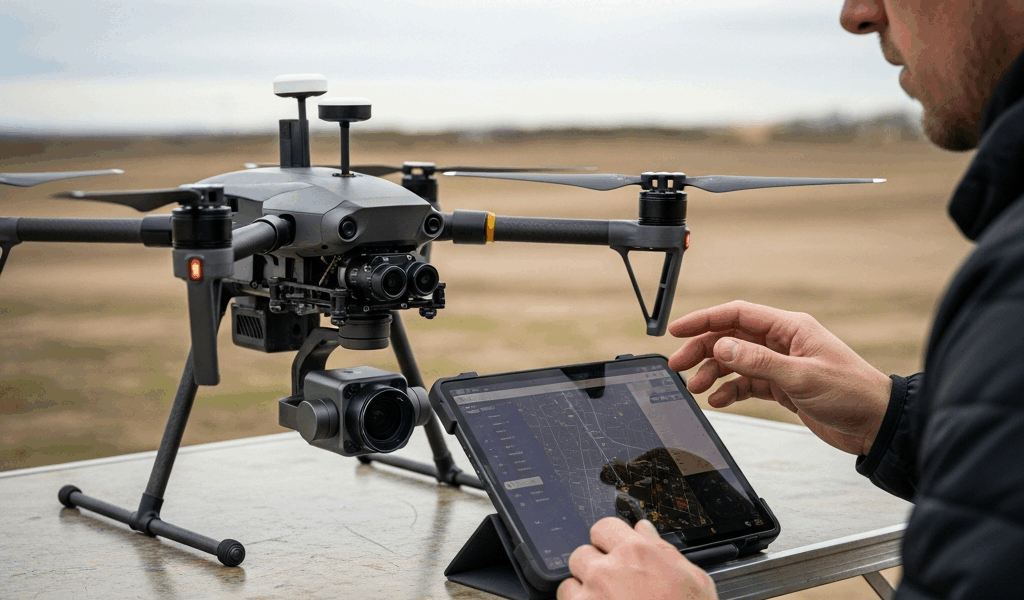
For the aircraft itself, include: maximum takeoff weight in grams (not pounds — the FAA’s forms use grams), maximum airspeed, endurance at operational payload, and propulsion type. If your aircraft is a modified commercial platform — say, a DJI Matrice 350 RTK with a custom payload — document the modification and how it affects the aircraft’s performance envelope. Unexplained modifications raise flags.
Collision Avoidance Plan
This section gets more scrutiny than almost anything else in a BVLOS application. The FAA’s primary concern with BVLOS is detect-and-avoid (DAA) — how does your operation ensure separation from manned aircraft when there’s no human eye on the drone?
Your collision avoidance plan needs to address three layers: strategic deconfliction (how you coordinate with airspace users before the flight), tactical deconfliction (how you maintain separation during the flight in near-real-time), and emergency procedures (what happens if separation is about to be violated). LAANC authorization handles part of the strategic layer in controlled airspace, but it doesn’t substitute for a full collision avoidance plan. The FAA wants to see all three layers addressed explicitly.
For operations below 400 feet AGL in low-traffic Class G airspace — a common BVLOS scenario — you can build a credible collision avoidance case around operational constraints: flying only during daylight, maintaining radio monitoring on 122.9 MHz CTAF near airports, filing NOTAMs, and using ADS-B In on the ground station to monitor traffic. ADS-B Out on the UAS strengthens the case considerably, even when it’s not strictly required by rule.
Specific Form Fields That Matter
In DroneZone, the “Proposed Area of Operation” field requires a KMZ or KML file defining your operational area. Make this tight. A 50-square-mile polygon submitted “just to be safe” signals to the reviewer that you haven’t actually defined a controlled operation. Define the smallest area that actually covers your mission. You can apply for an amendment later to expand it.
The “Mitigation Measures” free-text field is where most applicants write something generic and lose the reviewer. Be specific: “Operations are limited to the 3.2-mile corridor between GPS coordinates [X] and [Y], at altitudes between 100 and 300 feet AGL, during daylight hours only, with a dedicated visual observer at each end of the corridor positioned to observe and communicate via radio on [frequency].” That’s a mitigation. “Will follow all applicable regulations” is not.
Risk Mitigation Plan — What Gets Approved
Burned by a vague first submission, I rebuilt my mitigation approach around studying publicly available approved waivers. The FAA publishes a database of granted waivers — it’s searchable on the FAA website and worth several hours of your time before you write a single word of your own application.
Mitigations That Consistently Appear in Approved Applications
Approved BVLOS waivers in sparsely populated areas almost universally include: operations restricted to a specific geographic polygon, altitude caps (typically 400 feet AGL or lower), visual observers (VOs) at key positions with defined communication protocols, lost link procedures with specific aircraft behavior parameters, and operational restrictions tied to weather minimums (usually 3 statute miles visibility and 500-foot cloud clearance at minimum, often stricter).
For corridor operations — pipelines, power lines, railways — the strongest applications include a ground risk assessment showing population density along the corridor. The FAA uses the ASSURE ground risk framework in its internal reviews. You don’t have to submit a formal ASSURE analysis, but structuring your ground risk section to address population exposure, casualty probability, and shelter-in-place factors shows the reviewer you’ve done the work.
What Gets Rejected
Vague mitigations. Equipment without FCC documentation. Operational areas that include Class B, C, or D airspace without a specific ATC coordination plan — the FAA will not approve BVLOS operations that bleed into controlled airspace without a separate letter of agreement (LOA) from the relevant TRACON or tower. That coordination has to happen before the waiver is submitted, not after.
Over-reliance on detect-and-avoid technology as your primary mitigation also gets pushback. Saying “our aircraft has obstacle avoidance sensors” does not constitute a collision avoidance plan for manned aircraft. Ground-based obstacle avoidance and air traffic separation are completely different problems. The FAA knows the difference and expects your application to demonstrate that you do too.
Processing Timeline and What to Expect
The FAA targets 90 days for waiver processing. In practice, complex BVLOS applications frequently run 120 to 180 days. Set your project timeline accordingly. Do not submit a BVLOS waiver application expecting approval in time for a contract that starts in six weeks. That’s a lesson I learned expensively.
After Submission
After submitting through DroneZone, you’ll receive an acknowledgment email with a case number. Keep this. The FAA’s Flight Technologies and Procedures Division (AFS-80) handles waiver review. You can follow up by emailing 9-AVS-AFS-800-DroneWaiver@faa.gov with your case number after 60 days if you’ve received no correspondence. Don’t follow up weekly — it doesn’t accelerate the review and generates noise in their queue.
The most common correspondence you’ll receive mid-process is a Request for Additional Information (RAI). This is not a rejection. It’s the reviewer identifying gaps. Respond to every RAI item completely and specifically. A partial response to an RAI restarts the clock and signals that you’re going to be a difficult applicant to work with.
Common Rejection Reasons
Incomplete equipment documentation. No FCC IDs. Operational area overlapping restricted airspace without coordination. Lost link procedures that describe pilot intent rather than aircraft automation behavior. No weather minimums defined. Ground risk section absent or perfunctory. Collision avoidance plan relying entirely on ADS-B Out without additional procedural mitigations.
If you receive a denial, the FAA’s letter will specify the deficiencies. You can reapply. Many operators get approved on the second or third submission after addressing the specific feedback. The denial is data — use it.
Equipment That Has Been Approved for BVLOS
I’m not recommending any of these platforms. What I’m reporting is what shows up in the FAA’s public waiver records and in operational reports from operators who’ve been through the process. Equipment with an existing FAA track record in approved waivers reduces the documentation burden on your application — you’re building on established precedent rather than asking the FAA to evaluate novel technology.
Platforms With Documented Approval History
The Skydio X10 (and the earlier X2 Enterprise) appears in multiple approved BVLOS waivers, particularly for infrastructure inspection and public safety applications. Skydio’s obstacle avoidance system has been accepted as a supporting mitigation (not primary) in several approved packages. The aircraft’s logs and autonomous flight capabilities have been evaluated positively in FAA review contexts.
The DJI Dock 2 with the Matrice 3D/3TD has been included in approved BVLOS operations, primarily automated inspection corridors. DJI equipment’s FAA standing is complicated — the House passed the American Security Drone Act, and federal procurement restrictions apply — but civilian commercial operators are not currently prohibited from using DJI equipment in FAA waiver applications. That may change. Know the current status when you’re writing your application.
uAvionix equipment — specifically the Ping20Si ADS-B transceiver and the tailBeaconX — appears frequently in approved BVLOS packages as the ADS-B Out solution. uAvionix has FAA TSO approvals and a clear regulatory standing. Including their equipment in your command and control architecture is well-understood by FAA reviewers.
The Percepto Arc autonomous inspection drone has been used in approved BVLOS programs at industrial facilities. The company’s FAA engagement history and their published safety case structures are worth studying if you’re pursuing facility-based BVLOS for critical infrastructure.
What “FAA Track Record” Actually Means
Approved for one operator’s specific application doesn’t mean it will sail through yours. Equipment track record reduces friction — it means the FAA reviewer has a reference point. Your safety case still needs to be complete. Using a Skydio X10 doesn’t excuse a missing collision avoidance plan. Equipment choice is one variable. The rest of the application still has to stand on its own.
The operators who get approved consistently are the ones who treat the application as a genuine safety communication rather than a compliance exercise. The FAA reviewer reading your package is trying to determine whether your operation is genuinely safe. Write the application to answer that question, completely and specifically, and your chances improve substantially over the operators who submit the minimum and hope for the best.


Stay in the loop
Get the latest dronefaaregulations updates delivered to your inbox.