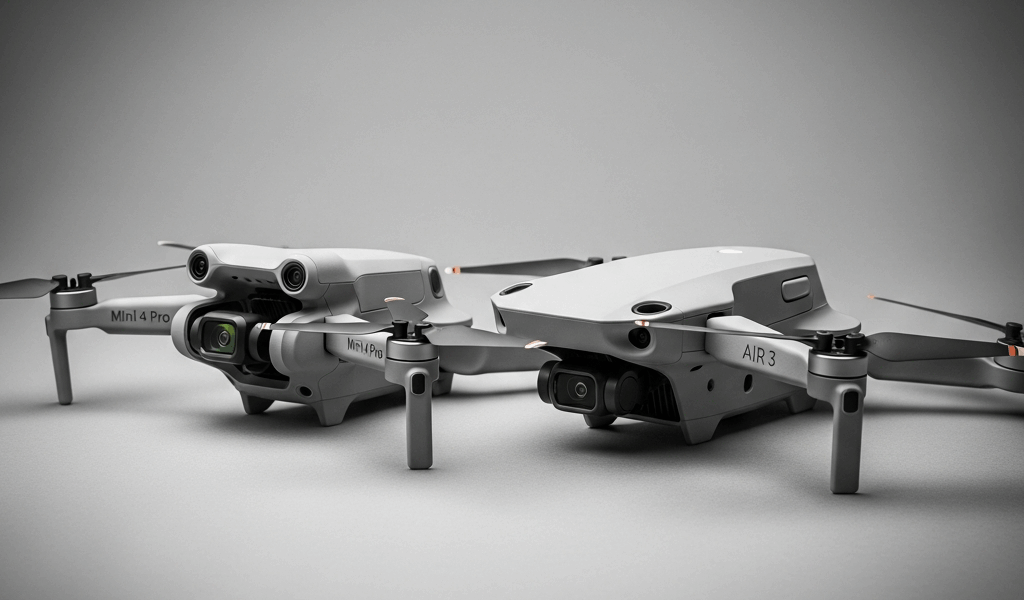
DJI Mini 4 Pro vs Air 3 — Quick Specs
The DJI Mini 4 Pro vs Air 3 debate comes up constantly in every drone forum, Facebook group, and Reddit thread I follow — and honestly, most comparisons miss the single most important factor for recreational pilots in the United States. We’ll get to that. First, let me give you the raw numbers side by side, because everything downstream of this table depends on it.
| Spec | DJI Mini 4 Pro | DJI Air 3 |
|---|---|---|
| Weight | 249 g | 720 g |
| Camera | 1/1.3-inch CMOS, single lens, 4K/60fps | 1/1.3-inch CMOS, dual lens (24mm + 70mm), 4K/60fps |
| Max Flight Time | 34 minutes | 46 minutes |
| Obstacle Avoidance | Omnidirectional | Omnidirectional |
| Price (MSRP) | $759 (standard) / $959 (Fly More Combo) | $1,099 (standard) / $1,349 (Fly More Combo) |
| FAA Registration Required | No (recreational) | Yes |
Both drones use the same size image sensor. Both have omnidirectional obstacle avoidance. The price gap is real — roughly $340 between standard models — but the weight gap is where the conversation actually starts.
The 249-Gram Advantage — Why Weight Matters for FAA Rules
Probably should have opened with this section, honestly. If you’re flying recreationally in the United States and you haven’t fully read through FAA drone regulations, the 249-gram figure on the Mini 4 Pro isn’t a coincidence. DJI engineered that number deliberately, and it changes everything about how you can legally operate.
Here’s the short version. Under FAA regulations, drones weighing 0.55 pounds (250 grams) or more must be registered with the FAA before flight. The Mini 4 Pro comes in at exactly 249 grams — one gram under the threshold. The Air 3, at 720 grams, clears that cutoff by nearly 500 grams. Not even close.
What FAA Registration Actually Involves
Registration costs $5 and takes about ten minutes on the FAA DroneZone website. It’s not the end of the world. But it also comes with responsibilities that follow you. Your registration number must be affixed to the aircraft. You must carry proof of registration during flight. And critically, once you’re registered, you’re more formally in the FAA’s system — which matters if anything goes wrong.
Flying the Air 3 without registering it is a federal violation. That’s not a hypothetical liability. That’s a real one.
The TRUST Test — Both Drones, Same Requirement
One thing I see confused constantly: the TRUST (The Recreational UAS Safety Test) is required for all recreational flyers, regardless of drone weight. Mini 4 Pro pilots still need to complete it. It’s free, takes maybe 20 minutes, and you can take it through any FAA-approved test administrator. Completion doesn’t expire. This is separate from registration — don’t mix the two up. I did when I first started flying, and it cost me an embarrassing conversation with a park ranger who knew more about the rules than I did.
Travel and Venue Access
Beyond registration, the sub-250g classification affects where you can realistically fly. Some national parks, state parks, and private venues that restrict drones will still accommodate sub-250g aircraft when approached correctly. Sports stadiums, certain beach areas, and travel destinations abroad have their own rules, and a 249-gram drone simply generates less friction in those conversations. I’ve flown the Mini 4 Pro in four countries without a single issue at airport check-in. The Air 3’s battery configuration also flags more frequently at security.
Camera Quality — When the Air 3 Dual Lens Wins
Surprised by how close these two cameras are at their base specs. Both use a 1/1.3-inch CMOS sensor. Both shoot 4K at 60fps. Both support D-Log M color profile for post-processing flexibility. In a side-by-side test on a calm morning shoot over a lake near my house, I genuinely had to pixel-peep to find meaningful differences in the primary wide-angle footage.
The Air 3 wins on one thing. One specific, meaningful thing.
The 70mm Telephoto Lens
The Air 3 carries a secondary 70mm equivalent telephoto camera — a 1/1.3-inch sensor, same as the main lens, shooting 4K/60fps independently. This isn’t a digital crop. It’s a dedicated optical lens with its own physical sensor. For wildlife photography, compressed architectural shots, or cinematic footage where you want that flattened background separation, the tele lens is a genuine creative tool. Nothing in the Mini 4 Pro’s single-lens system replicates it.
Driven by a client request for compressed real estate footage last spring, I ended up renting an Air 3 for a two-day shoot using a local gear shop’s daily rate of $85. The 70mm results on a beachfront property were exactly what the client wanted — flattened horizon, tight on architectural detail, sky compression that made the water pop. The Mini 4 Pro I normally fly couldn’t have delivered that.
But here’s the honest truth for most recreational pilots — the 70mm lens is a specialty tool. If you’re filming family vacations, travel content, hiking footage, or casual social media clips, the single wide-angle on the Mini 4 Pro captures stunning footage that the vast majority of viewers will never find lacking.
Video Features — Both Are Strong
- Both support 4K/100fps slow motion (Air 3) versus 4K/60fps on Mini 4 Pro
- Both have vertical shooting mode for social media formats
- Both support ActiveTrack 360 subject tracking
- The Air 3 adds a 10-bit D-Log M that gives slightly more latitude in heavy highlight recovery
The Air 3 edges ahead on video specs. Not by a massive margin for casual use, but for professional deliverables, those extra bits matter.
Wind Performance — The Air 3 Weight Advantage
Weight is a liability at the FAA registration desk. In the sky, it becomes an asset.
The Mini 4 Pro is rated to handle winds up to 10.7 m/s (approximately 24 mph, or Beaufort Scale Force 5). The Air 3 handles up to 12 m/s — about 27 mph. On paper, the gap seems modest. In practice, flying a 249-gram aircraft in 20-mph gusts is a genuinely uncomfortable experience. The drone fights to hold position, footage gets micro-jittery even with good stabilization, and battery drain accelerates noticeably as motors compensate.
I’ve had the Mini 4 Pro pushed sideways hard enough during a coastal shoot to trigger a low-battery RTH at a distance I wasn’t expecting. That doesn’t happen in calm conditions. Wind changed the equation fast.
The Air 3’s 720 grams gives it physical inertia. It holds position more cleanly in gusty conditions. The footage shows it — less micro-correction, smoother tracking shots, more confident hovering when the wind picks up suddenly. Coastal shoots, mountain ridge lines, open plains — these are Air 3 environments.
If you fly mostly in suburban areas, parks, or on calm mornings, this difference rarely surfaces. Know your flying conditions before you buy.
The Verdict — Which Drone for Which Pilot
These drones aren’t competing for the same pilot. Not really.
Buy the DJI Mini 4 Pro If —
- You fly recreationally and want to avoid FAA registration requirements
- You travel frequently and want the simplest possible equipment footprint
- Your budget tops out closer to $759 than $1,099
- You shoot travel content, family footage, or social media clips
- You fly in mild-to-moderate conditions most of the time
- You’re new to drones and want the most forgiving entry point into serious hardware
Buy the DJI Air 3 If —
- You shoot commercially and need the dual-lens versatility for client work
- You fly in coastal, mountain, or consistently windy environments
- Cinematic compression and telephoto framing are part of your regular creative toolkit
- You need longer flight time — 46 minutes versus 34 minutes is a real difference on longer shoots
- FAA registration is already part of your workflow (commercial pilots are already in the system)
The Mini 4 Pro is not the lesser drone. For recreational pilots in the United States, it’s arguably the smarter purchase in 2026 — the regulatory headroom alone justifies the choice for anyone who isn’t getting paid to fly. One gram under the registration threshold is an engineering decision that DJI made specifically for pilots who want simplicity, and it works.
The Air 3 is a professional tool wearing a consumer price tag. The dual-lens system, extended flight time, and wind resistance make it the right call the moment your flying becomes client-facing or technically demanding.
Figure out which category you’re in. Then buy that drone. The spec sheet won’t make the decision for you — your use case will.


Stay in the loop
Get the latest dronefaaregulations updates delivered to your inbox.