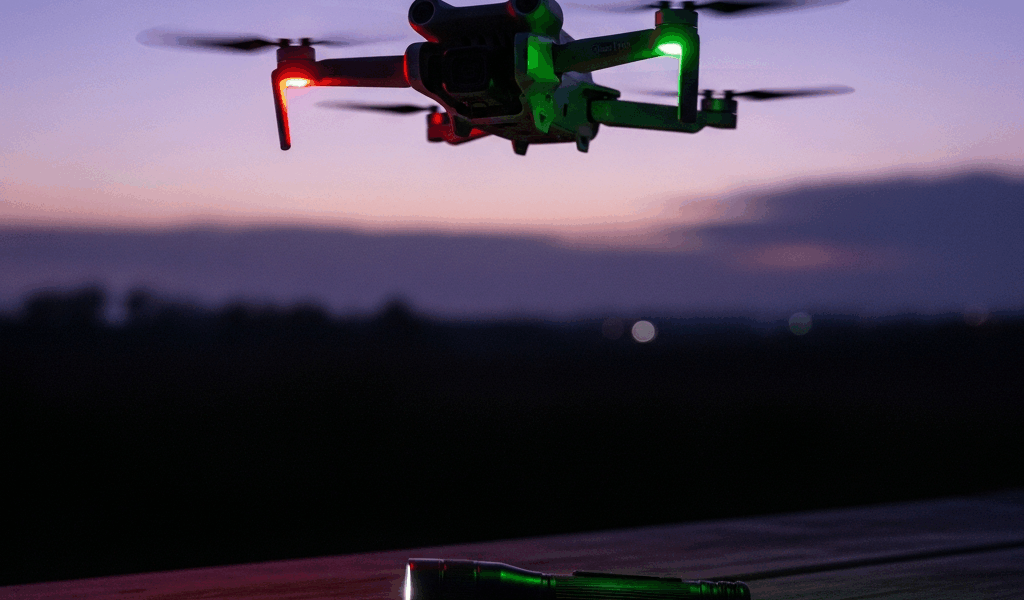
Can You Legally Fly the DJI Mini 4 Pro at Night—
Night flying with the Mini 4 Pro has gotten complicated with all the regulatory confusion flying around. The short answer: no, not without an FAA waiver. I learned this the hard way when I submitted my first night flight request thinking the Sub-250-gram weight would somehow grant me an exemption. It doesn’t.
Federal Aviation Regulation 14 CFR 107.29 explicitly prohibits night operations for all Part 107 drone pilots, regardless of aircraft weight. The regulation states you cannot operate a small unmanned aircraft during civil twilight—that’s 30 minutes before official sunrise through 30 minutes after official sunset—unless you have an approved waiver and anti-collision lighting visible from at least three statute miles away.
Here’s the critical distinction most people miss. The DJI Mini 4 Pro’s built-in LED indicator light? It doesn’t qualify as anti-collision lighting under FAA standards. That tiny blinking light is for your visual reference only. The FAA requires external lighting systems that are far brighter and positioned to meet specific visibility thresholds. The regulation applies equally to every Part 107 operator flying any aircraft under 55 pounds — no exemptions based on weight class.
I’ve seen pilots rationalize flying low or staying in their backyard, assuming enforcement won’t happen. That’s exactly how FAA enforcement actions start. The agency takes night operations seriously because collision risk increases dramatically without proper lighting. You need explicit authorization. Period.
What You Need Before Flying at Night—
Three hard requirements exist before your first legal night flight:
- A valid Part 107 remote pilot certificate
- Anti-collision lighting meeting the three-statute-mile visibility standard
- An approved waiver from the FAA
Let me break down the lighting requirement because this is where most people get tripped up. The Mini 4 Pro can carry external light kits designed specifically for night operations. The Firehouse Arc II weighs just 16 grams and mounts via the drone’s existing accessory port. Another solid option is the Lume Cube Strobe — around 24 grams. Both systems produce white strobe lights visible well beyond three statute miles when operating at night.
Weight matters here. Probably should have opened with this, honestly. Adding external lighting increases your Mini 4 Pro’s total takeoff weight, which directly affects battery life and flight characteristics. With the Firehouse Arc II mounted, you’re looking at roughly 8-10 minutes of reduced flight time compared to unlit operations. That’s a real tradeoff you need to accept before committing to night flying.
Your Part 107 certificate is non-negotiable. This requires passing the aeronautical knowledge test — 107 questions, 60-minute limit, 70% passing score minimum — and obtaining your remote pilot license from the FAA. Already hold one? Halfway there.
The waiver is the authorization that lets you legally deviate from 14 CFR 107.29. Without it, you’re flying in violation of federal law. Civil penalties go up to $27,500, and repeat violations carry potential criminal charges. The FAA has actually levied those fines.
How to Get an FAA Waiver for Night Operations—
The application process moves through the FAA’s online portal called DroneZone. You’ll submit your request, and typically the FAA responds within 30-60 days — though some applications take longer if they need additional clarification.
Here’s the step-by-step process I followed:
- Create or log into your FAA DroneZone account
- Select “Request a Waiver or Airspace Authorization”
- Choose “Night Operations” from the available waiver categories
- Fill in your operational plan with specific details about where, when, and how you’ll fly
- Submit documentation proving your drone has anti-collision lighting
- Include your Part 107 certificate information
- Wait for FAA review and approval
Your operational plan is critical. Generic descriptions like “flying my drone at night in my area” will get denied immediately. Instead, specify exact coordinates — latitude and longitude — altitude limits, specific dates and times, your operational purpose, and safety procedures. Filming real estate at night? Explain the filming location, distance from residential areas, and why nighttime flying is necessary for your client. Conducting infrastructure inspection? Provide facility details and inspection objectives.
The lighting documentation should reference your specific light kit model, its visibility range, brightness specifications, and mounting configuration. I included the manufacturer’s spec sheet for the Firehouse Arc II along with photos showing it mounted on my actual drone. The examiner needs to understand exactly what system you’re using.
What separates strong applications from weak ones comes down to specificity. The FAA cares about two things: safety and airspace congestion. Your application needs to prove you’ve thought both through. Vague applications generate requests for additional information, which extends timelines. Detailed applications move faster.
My first waiver approved in 34 days. A colleague’s took 58 days because his operational plan lacked specific coordinates and didn’t clearly explain why night operations were necessary for his mapping project.
Setting Up Lighting on Your DJI Mini 4 Pro—
The internal LED simply won’t cut it. This is non-negotiable from an FAA perspective, and it also makes practical sense. When you’re flying at night, you need your own lights to see the drone — not just an indicator light at a distance. The anti-collision lights serve dual purpose: they satisfy regulatory visibility requirements and they help you maintain visual line of sight (VLOS), which is required under Part 107 regardless of lighting status.
I tested three light kits on my Mini 4 Pro: the Firehouse Arc II, a DIY LED rig that cost $35, and the Lume Cube Strobe. Here’s what actually happened.
The Firehouse Arc II — retail around $80-95 — mounts directly into the Mini 4 Pro’s light slot and integrates with the remote controller via USB-C. You toggle it on through the DJI Fly app. Brightness is excellent, easily visible from 200+ feet at night. Light output stays consistent and the system weighs almost nothing relative to the drone’s lifting capacity. Downside: it’s proprietary to DJI, so upgrading drones means potentially needing different mounts.
The DIY rig used small white LEDs, lithium coin cell batteries, and velcro mounting. I spent three hours soldering connections and testing brightness. It was visible from about 150 feet in complete darkness. The novelty wore off quickly. When the first light connection failed mid-flight, I realized engineered reliability beats weekend projects every time.
The Lume Cube Strobe — $150-170 retail — is heavier and requires custom mounting. It strobes at 100 flashes per minute, creating a distinctive visual signature excellent for detection. Flying in busy airspace where other aircraft might appear? This is the premium option. Downside is weight and complexity — another battery to manage, another connection point to fail.
My recommendation for most Mini 4 Pro night operations: the Firehouse Arc II. It’s purpose-built for this drone, it’s affordable, and it meets every FAA requirement. Balance and handling remain predictable, battery drain is minimal, and reliability is excellent.
Mount your chosen light kit before submitting your waiver application. This lets you photograph it mounted on your actual drone and include those images. The FAA wants to see the actual configuration you’ll use — not theoretical setups.
Common Mistakes That Get Waiver Requests Denied—
I’ve reviewed rejected applications from other pilots, and patterns emerge quickly. Here’s what actually kills approval chances.
First: vague operational plans. Statements like “night photography in residential areas” provide zero actionable information. The FAA needs coordinates, altitudes, specific dates, and clear justification. One denial letter simply said “Insufficient operational detail provided.” The applicant had submitted three sentences. Include maps, exact addresses, distance buffers from obstacles, and safety procedures. Go into uncomfortable detail.
Second: unclear lighting specifications. Don’t assume the examiner knows your light kit. Provide the model number, manufacturer, visibility specifications, and mounting method. Using custom or DIY lighting? Include technical drawings showing brightness output, frequency (strobe versus steady), and mounting specifics. One pilot’s waiver was denied because he wrote “LED lights visible from far away” — no specs, no model, no verification. The examiner had no way to confirm standards compliance.
Third: flying in Class B or C airspace without explicit approval. Night operations waivers and airspace authorizations are separate approvals. You can’t get night approval and assume you can fly near a major airport. Some airspace requires additional authorization. Check your local airport’s airspace classification before submitting. I made this mistake and had to reapply with airspace authorization included — extended my timeline another month.
Fourth: inadequate safety procedures. Write out contingency plans. What happens if you lose the drone? Where will it land? How will you recover it? Weather suddenly deteriorates? You lose VLOS? Your application should demonstrate you’ve thought through failure scenarios — not just best-case flying conditions.
Fifth: submitting from a different location than your operational area. Use your actual address, not a mail drop. The FAA cross-references applications with your remote pilot certificate information. Discrepancies trigger additional review and potential denial.
Start your waiver application early. Don’t submit two weeks before you need to fly. Use the 30-60 day timeline as baseline and add buffer. Once approved, your waiver is valid for two years from approval date — so the effort compounds in your favor over time.


Stay in the loop
Get the latest dronefaaregulations updates delivered to your inbox.