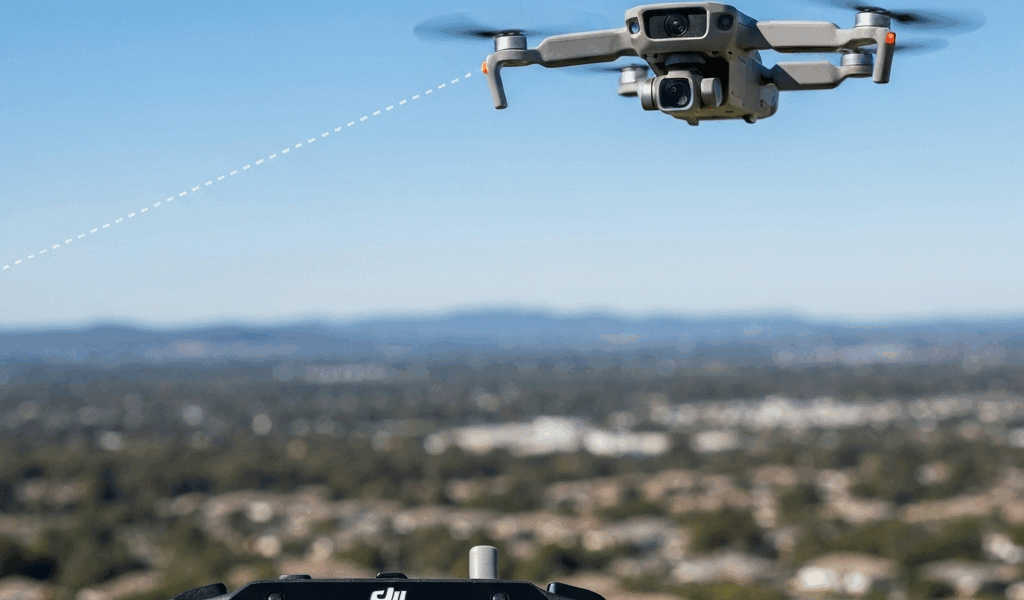
What the DJI Mini 4 Pro Specs Say About Range
I spent three hours reading through DJI’s official specs sheet for the Mini 4 Pro, and here’s what jumped out at me: the remote controller has a maximum transmission range of approximately 20 kilometers under ideal conditions. That’s roughly 12.4 miles of signal distance — on paper, that’s impressive for a $759 drone.
But that number is doing a lot of heavy lifting, and most people misread it entirely.
When DJI publishes “20km range,” they’re talking about the radio signal distance. The farthest point at which the controller can still communicate with the drone’s receiver. This gets measured in an open field with zero interference, clear line of sight between the controller antenna and the drone’s antennas, and optimal atmospheric conditions. It assumes you’re standing still, the drone is stationary, and there’s no electromagnetic noise from cell towers, WiFi networks, or power lines.
Range specs are real. They’re manufacturer claims, and they’re verifiable. But here’s the thing — they describe signal transmission capability, not regulatory flying distance.
I made the mistake early on of assuming these numbers meant anything about where I could legally operate. They don’t. Understanding this distinction? That’s the entire game for Part 107 compliance.
Visual Line of Sight — VLOS — Requirement Explained
Title 14 Code of Federal Regulations Section 107.31 is where the FAA’s VLOS rule lives. Here’s the exact language: “No person may operate a small unmanned aircraft system unless the small unmanned aircraft remains within visual line of sight of the person operating the small unmanned aircraft or, in the case of a group operation, the visual observers.”
VLOS means you must see the drone with your own unaided eyes. Not on a monitor. Not through FPV goggles. Your actual eyes.
The rule also permits you to use a visual observer (VO) — another person stationed elsewhere — but that observer must also maintain unaided visual contact. You can’t use binoculars or magnification devices to extend your sight line. The intent is direct human perception.
I’ve watched Part 107 test-takers stumble here because they conflate signal range with legal range. A common misconception: “The FAA says you can fly 500 feet away.” That’s not actually an FAA rule — it’s a rough guideline that emerged from industry practice, and honestly, it’s misleading because VLOS is subjective to your eyesight, the drone’s color, lighting, and altitude.
On a clear day with a white Mini 4 Pro against blue sky, I lose visual contact around 200–250 feet at eye level. Even though I know exactly where to look. Add glare, a smaller drone, or overcast conditions, and that shrinks further. Someone with poorer vision might lose it at 150 feet.
The FAA doesn’t enforce a fixed distance. They enforce the principle: you must see it without electronic aids. That’s the law.
Why the Mini 4 Pro Range Exceeds Legal Limits
The Federal Aviation Administration’s rules predate modern consumer drone technology by decades — the VLOS requirement emerged from manned aviation safety logic. Keep your aircraft where human observers can detect hazards like other traffic or terrain obstacles.
Modern radio transmission technology, especially 5.8 GHz frequency bands, can transmit signals miles beyond what any human can see with their eyes. The DJI Mini 4 Pro’s engineering is fundamentally more capable than the regulation allows.
This isn’t a flaw in the drone. It’s a gap between technology and regulation.
The FAA’s concern isn’t whether your remote can reach your drone — it’s whether you can detect airspace hazards. Manned aircraft, birds, obstacles. Those hazards exist within roughly 500–1,000 feet of the ground for small drones in most scenarios. Beyond visual range, you lose situational awareness. That’s the actual safety principle.
Every commercial drone operated under Part 107 lives with this constraint. The DJI Air 3 has even longer range capabilities — so does the Auteryx system. They’re all limited to VLOS operations unless you hold a waiver from the FAA. This is normal. This is intentional.
How to Test Range Safely and Stay Compliant
If you’re studying for Part 107 or you’re simply curious about your Mini 4 Pro’s actual capabilities, there’s a right way to test range without violating regulations.
First, you should secure a location — at least if you want legitimate data. Open field, minimal obstacles, minimal radio interference. An abandoned runway, large parking lot, or athletic field works. You need at least 1,000 feet in every direction — that gives you room to fly and document distance accurately.
Second, bring a spotter. This person’s job is to maintain visual contact with the drone while you monitor telemetry and signal strength on the controller display. The spotter should have good eyesight and binoculars if allowed — note that binoculars are permitted for spotters under Part 107 guidance, though they can’t substitute for unaided VLOS.
Third, mark distances. I use measuring wheels or GPS-marked waypoints. Start at 100 feet and increase in 50-foot increments — at each distance, note the signal strength (usually displayed as a percentage or dB value on DJI controllers), latency in milliseconds, and whether the spotter maintains visual contact.
Fourth, document what degrades first: video signal, control latency, or visual contact. With the Mini 4 Pro, I found that signal strength remained strong past 800 feet, but my ability to see the drone reliably degraded around 300–400 feet depending on sky conditions and drone orientation.
This test shows you the technical range of the radio system versus your practical VLOS envelope. The VLOS envelope — where you can actually see the drone — is where you legally fly. Range testing and compliant flying are different activities. Testing pushes limits in a controlled setting for education. Flying operationally stays within VLOS at all times.
Part 107 Exam Questions You’ll See on This Topic
If you’re preparing for the FAA Part 107 knowledge test, expect questions that probe whether you understand VLOS versus signal range. Here are three realistic examples:
Question 1: Your DJI Mini 4 Pro’s remote controller has a maximum transmission range of 20 kilometers. You’re operating in an open field on a clear day. What is the maximum distance at which you may legally fly the drone?
A) 20 kilometers, because that’s the manufacturer’s rated range.
B) Whatever distance you can maintain visual line of sight with your unaided eyes.
C) 500 feet, per FAA regulation.
D) 2 kilometers, the standard small UAS operating range under Part 107.
Correct Answer: B. VLOS is the limiting factor under 14 CFR 107.31, not the radio transmission range. Manufacturer specs are irrelevant to legal operating distance. The “500 feet rule” (C) is an informal guideline, not regulatory. Part 107 has no fixed distance limit (D) — it requires VLOS.
Question 2: You’re operating a small UAS with a visual observer 600 feet away. The VO confirms visual contact with the drone at 550 feet distance. You cannot see the drone yourself from your location. Is this legal?
A) Yes, the visual observer satisfies VLOS requirements.
B) No, you personally must maintain visual contact.
C) Yes, provided the VO uses binoculars to maintain sight.
D) Only if the drone’s control signal reaches your location.
Correct Answer: A. Part 107 explicitly allows operations where a visual observer maintains VLOS, even if the pilot-in-command cannot see the drone directly. The VO’s unaided visual contact is sufficient — C is incorrect because binoculars can assist but aren’t required. Signal range (D) is independent of VLOS legality.
Question 3: Your drone loses radio signal at 2 kilometers distance during a range test. At what point does VLOS become impossible to maintain?
A) At 2 kilometers, when signal loss occurs.
B) Long before signal loss, when the drone becomes too small to see clearly.
C) Only if the FAA defines a specific distance limit in Part 107.
D) When your visual observer reports they’ve lost sight of the drone.
Correct Answer: B. Visual range and signal range are independent. Most small drones become impossible to see reliably before radio signals degrade. The FAA doesn’t define a fixed distance (C) — VLOS is qualitative. Signal loss (A) is irrelevant to whether you can see the drone. The VO’s report (D) is the actual enforcement mechanism, but the regulation requires maintaining VLOS before that point.
Probably should have opened with this section, honestly. These questions reveal the exact confusion the regulation addresses.

Stay in the loop
Get the latest dronefaaregulations updates delivered to your inbox.