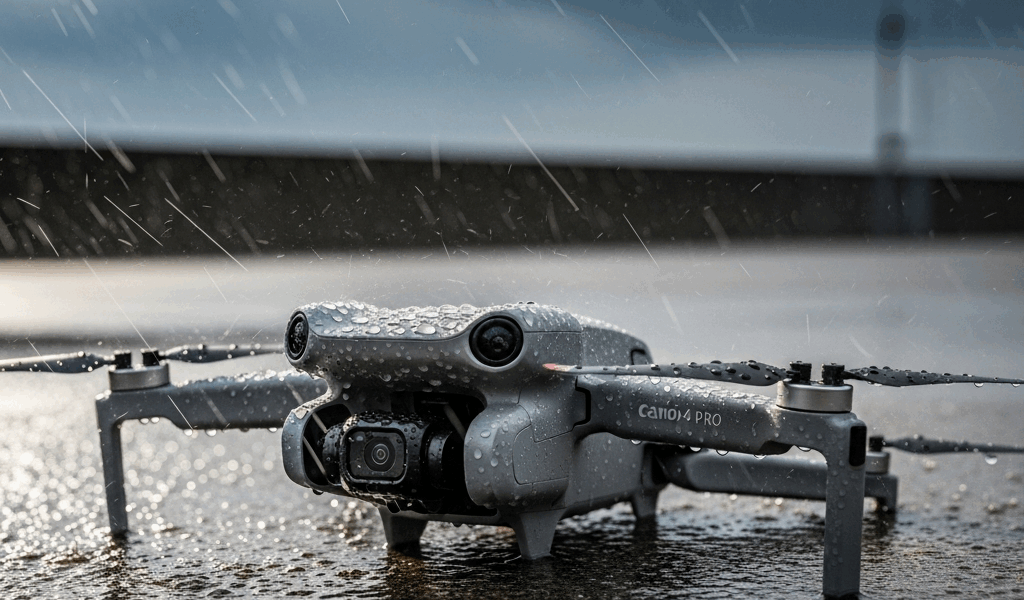
Short Answer on Rain and the Mini 4 Pro — Can It Actually Fly?
Flying a Mini 4 Pro in the rain has gotten complicated with all the misinformation flying around. No IP rating. Not designed for rain flight. Full stop.
I want to address this upfront because I’ve seen it everywhere — marketing copy and sketchy forum posts throwing around phrases like “water resistant” or “handles light drizzle.” That’s not DJI’s position. Not even close. There’s a real difference between vague marketing language and an actual IP (Ingress Protection) certification. An IP67 rating means a device survives immersion up to 1 meter for 30 minutes — tested, certified, warranted. The Mini 4 Pro has none of that. What you actually have is a $760 drone with standard consumer electronics enclosures that moisture will absolutely destroy. Think battery failure, gimbal malfunction, corrupted video files. That’s what water ingestion looks like in practice.
If you got caught in unexpected weather already, skip down to the troubleshooting section. If you’re planning a flight in known rain — don’t fly.
What DJI Actually Says About Water Exposure
Pulled straight from DJI’s official Mini 4 Pro documentation: no environmental sealing beyond standard consumer electronics tolerances. Light moisture in the air won’t destroy it immediately. Persistent water contact will.
That distinction matters. It’s the difference between a close call and a warranty-voiding, drone-killing mistake.
Splash Resistance Versus Waterproofing
But what is splash resistance, exactly? In essence, it’s an unofficial tolerance — the kind most consumer drones quietly survive — where brief water droplets, ocean spray, or light mist don’t cause immediate damage. But it’s much more than that, or rather, much less: it’s not engineered, not tested, not warranted. The Mini 4 Pro doesn’t even meet that informal bar according to DJI’s own specs.
Waterproofing is an entirely different category. Certified. Engineered with sealed seams and gaskets rated to specific pressures. Your Mini 4 Pro is neither.
What actually voids your warranty? Liquid damage to the camera, gimbal, battery, or mainboard. DJI won’t cover a flyaway caused by water-damaged electronics — most claims I’ve reviewed in pilot forums get denied within 48 hours, sometimes faster.
The Spectrum of Water Exposure
Not all water is the same. Context matters here:
- Light mist: Moisture in the air, no visible precipitation. The Mini 4 Pro tolerates this briefly. Minutes, not hours — and only barely.
- Drizzle: Fine rain, barely wetting the ground. This is where things escalate fast. Even 30 seconds of drizzle can seep into the gimbal housing. The camera lens fogs immediately, killing video quality and causing autofocus failure mid-shot.
- Steady rain: Don’t fly. Battery contacts corrode quickly. The magnetic gimbal connector absorbs moisture like a cotton swab.
The sneaky problem isn’t immediate failure. Water enters the seams, dries invisibly inside the body, and then causes failure five flights later — when you’re shooting over a lake and suddenly have no aircraft.
FAA Rules on Flying in Rain and Low Visibility
Probably should have opened with this section, honestly, because legality matters just as much as hardware durability. Even if your Mini 4 Pro could physically survive rain — which it can’t — federal regulations might prohibit the flight entirely.
Recreational Flying Under Exception 44809
Flying recreationally under the Part 107 exemption for model aircraft? The FAA requires you to maintain visual line of sight at all times. Rain creates visibility problems. If precipitation is heavy enough that you can’t clearly see your aircraft without squinting or relying solely on the video feed, you’re in violation. The FAA doesn’t name a specific rain type — it comes down to whether you can actually see the drone and maintain safe separation from other aircraft.
They also require you to avoid any conditions that would prevent a safe emergency landing. Rain qualifies.
Part 107 Certified Pilots
Commercial operators under Part 107 have explicit minimums: 3 statute miles of visibility. That’s the legal floor. Rainy day with visibility dropping to 2.5 miles? You can’t legally launch — doesn’t matter if you’re fully certified. Cloud clearance rules stack on top of that: 500 feet lateral distance and 1,000 feet vertical distance from clouds, both required simultaneously.
Steady rain typically drops visibility to 1–2 statute miles depending on intensity. Most rain events put you below the Part 107 threshold automatically — no gray area involved.
The civil penalty for violating weather minimums runs $27,500, plus potential suspension of your Part 107 certificate. Don’t make my mistake of assuming “it’s just drizzle” is a legal defense. It isn’t.
What Happens If Your Mini 4 Pro Gets Wet Mid-Flight
Caught by unexpected weather? Here’s the immediate plan.
Landing and First Response
Land as soon as safely possible. Don’t fly around searching for shelter — every second airborne pumps more moisture into the gimbal housing and battery contacts. Once grounded, power down immediately. Don’t attempt another flight “just to check if it’s okay.” Don’t plug in the battery.
Inspection and Drying
Pull the battery out and let everything sit at room temperature — somewhere between 65–75°F — for at least 4 hours minimum. Check the battery bay contacts for visible moisture or any discoloration. If those gold pads look anything other than clean and metallic, corrosion has already started.
Check the gimbal connector next — that circular magnetic port where the camera attaches. Moisture visible inside the recess? Dry it gently with a cotton swab. Skip the heat gun and skip the compressed air — both force water deeper into sealed cavities rather than removing it.
Let the aircraft air-dry for a full 24 hours in a warm, low-humidity room. A silica gel packet placed near the drone — not touching it — helps pull ambient moisture. Don’t seal it in a zip-lock bag until it’s completely dry. That traps moisture inside and accelerates corrosion.
The Battery Safety Rule You Probably Missed
Do not charge a wet battery. Ever. Lithium cells can short internally and catch fire with current running through moisture. I’m apparently more cautious about this than most — and my charging hub has never swelled or overheated, while plenty of pilots I know have had exactly that happen.
I know a pilot in Colorado — flies commercially, has his Part 107 — who charged his Mini 3 Pro battery too soon after a rain exposure incident. The cell swelled during charging and destroyed a $400 Smatree charging hub. Nearly started a garage fire. That was a Tuesday afternoon in March. Don’t make his mistake.
After the full 24-hour dry period, connect the battery and observe it for 10 minutes without walking away. Gets warm? Smells odd? Charging hub throws an error code? Stop immediately and dispose of that battery at a proper electronics recycling drop-off — most Best Buy locations take them free of charge.
Drones That Are Actually Rated for Wet Conditions
If you genuinely need all-weather capability — commercial inspections, emergency response work, coastal mapping operations — the Mini 4 Pro isn’t your tool. Full stop.
The DJI Matrice 300 RTK carries an IP45 rating, meaning it’s protected against water jets from any direction. The Autel EVO Max 4T is fully weatherproofed and carries both thermal and optical payloads for serious professional work. Both run $10,000–$20,000 depending on configuration, and both require Part 107 certification to operate legally in commercial settings. That’s what makes those platforms endearing to professional operators — they’re built for the conditions where the work actually happens.
So, without further ado, the practical answer for most recreational pilots and small Part 107 operations: wait for clear skies, schedule flights between storm windows, or build a weather buffer into your production timeline. For the occasional unexpected drizzle, the answer hasn’t changed — land immediately, dry the drone completely, and check the battery before you ever charge it again.
Flying the Mini 4 Pro in rain is a hardware problem and a legal problem simultaneously. The solution to both is identical: don’t fly in rain.


Stay in the loop
Get the latest dronefaaregulations updates delivered to your inbox.