What BVLOS Means and Why the FAA Restricts It
This article includes affiliate links. We may earn a commission at no extra cost to you.
BVLOS has gotten complicated with all the misinformation flying around—so let’s cut through it. Beyond Visual Line of Sight operations are exactly what the name suggests: you’re piloting an aircraft past the point where your own eyes can track it. As someone who spent three years grinding through Part 107 VLOS missions before pursuing my first BVLOS waiver, I learned everything there is to know about why the FAA treats this so differently from standard drone work.
But what is the core problem here? In essence, it’s situational awareness—or the sudden absence of it. But it’s much more than that. The moment your drone slips past visual range, you lose the immediate, instinctive sense of what it’s doing and what’s sharing that airspace with it. Part 107.31 caps altitude at 450 feet for a reason. That keeps your aircraft below the traffic patterns where Cessnas and medical helicopters actually operate. Push into BVLOS territory and you’re now sharing sky with a DJI Matrice 300 running at 1,200 feet—and nobody on either side can see the other.
Ground risk is just as ugly. I flew utility inspections for a municipality for two years before I ever touched BVLOS work. One afternoon, a gust shoved my Phantom 4 Pro toward a residential stretch I hadn’t accounted for. The video feed cut out—maybe four seconds, felt like forty. Heart-stopping doesn’t cover it. Scale that moment up to an uncontrolled drone drifting over populated neighborhoods and you understand exactly what the FAA is trying to prevent.
Section 107.31 doesn’t leave wiggle room. Fly BVLOS without authorization and you’re in violation of federal aviation regulations—civil fines climb to $27,500, and criminal charges exist for the truly spectacular failures. Don’t make my mistake of underestimating how seriously they enforce this. I’ve never personally met anyone who tested those penalties, but the cases are real and public.
Three Paths to BVLOS Approval
The FAA doesn’t hand out a single approved template for BVLOS operations. What they offer instead is evaluation across three distinct operational concepts—each with its own complexity level, cost structure, and honest probability of actually getting approved. Knowing which path fits your mission before you write a single word of your application saves months of wasted revision cycles.
Visual Observer Networks
The visual observer approach—VO network operations in the shorthand—places additional certified Part 107 pilots at strategic points along your flight path. Each observer holds VLOS on the aircraft, then hands off responsibility to the next person as it moves through their sector. It’s essentially a relay race through controlled airspace, and that’s what makes VO networks endearing to us Part 107 pilots: the FAA already understands human eyeballs. You’re not asking them to trust new technology.
Startup costs are low. No specialized avionics required. The concept translates intuitively in the application.
The practical reality? Messier. I attempted a VO network for a power line inspection spanning eight miles—five observers minimum, spaced roughly 1.5 miles apart, synchronized by radio with tight timing requirements. Labor alone ran $4,200 for a single mission day. Weather pushed us back twice, which meant rescheduling five licensed pilots twice. One observer didn’t show on the actual mission date. We scrapped the project entirely.
That said, these do get approved—the FAA cleared over 150 VO operations in 2024. They work best for shorter distances in remote areas where positioning observers isn’t a logistical nightmare. Pipeline corridors, agricultural surveys, linear infrastructure work. Those fit.
Shielded Operations
Shielded operations use physical or geographic barriers to eliminate the risk equation outright. Your drone runs BVLOS but within enclosed airspace where encountering manned aircraft—or drifting over populated ground—is genuinely impossible by design. Military test ranges and private airfields with established restricted airspace sometimes qualify.
This is the fastest approval path, apparently by a significant margin. I’ve seen shielded operation waivers processed in 60 days. The FAA’s risk calculus becomes simple: if the aircraft physically cannot reach populated areas or interfere with traffic, the regulatory burden drops substantially.
The catch is access. You need controlled airspace the FAA recognizes as legitimately restricted—not just rural, not just private land. A sprawling ranch in Nevada might qualify. Your remote Wyoming property probably doesn’t. Most Part 107 pilots, myself included, don’t have realistic access to suitable locations.
Detect-and-Avoid Systems
Detect-and-avoid—DAA—is where the FAA is genuinely building the future regulatory framework. Onboard sensors, typically ADS-B receivers, LIDAR, or radar, detect nearby manned aircraft and either alert the pilot or trigger automatic avoidance maneuvers. In theory, your drone assumes traffic separation responsibility the way a manned pilot would.
In practice, DAA approval is the most demanding path available. Full stop.
The documentation requirements alone are staggering—performance data, failure mode analysis, redundancy specs, testing records. Airborne Tactical Advantage Company manufactures one of the few FAA-validated systems, the Airborne Collision Avoidance System for Unmanned Aircraft—ACASA. Hardware runs $30,000 to $50,000. Testing and certification tack on another $15,000 to $25,000. I examined DAA integration for industrial inspection work last year and the performance specs are extraordinary: aircraft detection within two nautical miles, minimum ten seconds of warning time, false alert rates below ten percent. No commercial drone today meets those standards without external hardware integration that roughly doubles aircraft weight and cuts flight time in half.
DAA might be the best long-term option, as BVLOS scalability requires automated separation capability. That is because human observer networks simply don’t scale economically across complex airspace. The FAA approved its first DAA-based commercial BVLOS operation in late 2023. It’s the future—just probably not your immediate path if you’re filing in 2026.
How to Write a BVLOS Waiver Application
Probably should have opened with this section, honestly. But the background matters—understanding why the FAA is cautious shapes how you write for them.
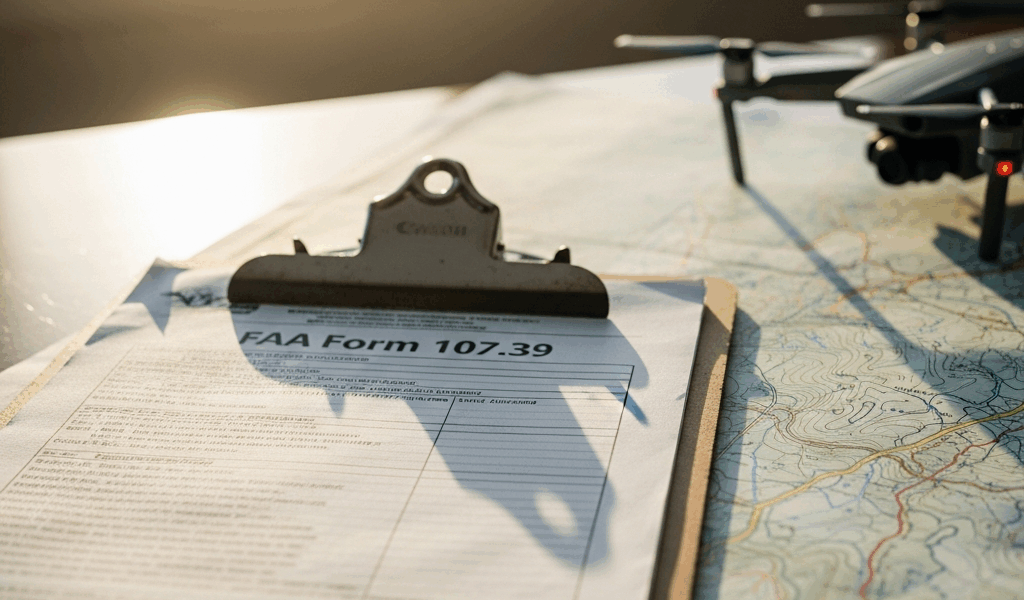
Your application starts with FAA Form 7711-2, Request for Certificate of Waiver or Authorization, submitted through the DroneZone portal. The form itself is straightforward—name, aircraft description, operation summary. Nine pages in my approved application. Don’t let the simplicity fool you. The supporting documentation is where approval actually lives or dies.
Risk Identification and Mitigation
The FAA organizes risk into three categories—air traffic, ground, and operational—and your application needs to address all three with specificity, not good intentions.
Air traffic risk is the collision problem. Document your operational altitude, airspace class, typical traffic density, and specific procedures for avoiding known aircraft. Class B or C airspace requires ATC coordination—documented, written coordination. First rejection I ever received came back in 45 days with one terse line: “Applicant has not demonstrated coordination with ATC.” I’d proposed BVLOS near a regional airport without mentioning ATC once. Embarrassing, and expensive in time.
Ground risk covers people and structures below. Your application needs geographic boundaries with actual coordinates—altitude floors and ceilings, exclusion zones, population density data. More importantly, it needs your lost-link procedure. What does the drone do when it loses GPS lock or signal? Where does it go? Does it return to launch autonomously or does it drop? The FAA wants a written answer, not a shrug.
Operational risk covers the human factors—pilot error, equipment failure, weather. This is where your personal credibility as a Part 107 operator becomes a real asset. Flight logs, training records, incident reports—yes, even minor ones. Honesty builds FAA credibility faster than a clean record that looks too clean.
Common Rejection Reasons
Insufficient risk mitigation tops the list, and it shows up in three specific patterns I’ve seen repeatedly:
- No loss-of-signal procedure. “The aircraft will return to launch” is acceptable. “I’ll assess the situation” gets automatic rejection.
- Undefined operational boundaries. Coordinates, altitude floors and ceilings, exclusion zones—the FAA wants to know precisely where your aircraft can and cannot be at any given moment.
- Inadequate ATC coordination. If your operation touches anything beyond the most remote uncontrolled airspace, you need documented communication with the relevant facility. Not optional.
Weather minimums cause more rejections than people expect. “I’ll fly when conditions are good” isn’t a weather statement—it’s a red flag. You need specific numbers: minimum visibility in statute miles, cloud ceiling in feet, maximum wind speed in knots. My approved operations use 10 statute miles visibility, 1,000-foot ceiling, and 15-knot winds. Conservative, but they hold up under scrutiny.
Personnel qualifications trip up applicants who assume Part 107 alone is sufficient. The certificate matters—it’s the floor, not the ceiling. BVLOS-specific training signals to reviewers that you’ve taken this seriously beyond the standard exam. A one-day workshop isn’t transformative, but it’s documented evidence of additional preparation.
BVLOS Approval Timeline and Success Rate
The FAA doesn’t publish official BVLOS waiver statistics—you have to pull this through public records requests and FOIA disclosures. The numbers are sobering but the trend has shifted.
In 2022, approval rates hovered around 35 percent. Processing ran 90 to 120 days. By 2024, approval climbed to nearly 55 percent—processing held steady at 90 to 110 days. Airspace complexity pushes those timelines around significantly. Class D or busier means 120 to 180 days, sometimes longer, because ATC coordination adds bureaucratic layers. Remote, uncontrolled airspace can move faster—75 to 90 days, occasionally.
Frustrated by vague guidance on what actually gets approved, I started tracking patterns across disclosed waiver data. What successful applications share isn’t polish—it’s ruthless honesty. The applicants who get through don’t minimize risks. They name them explicitly and explain mitigation in technical detail. They attach weather data, airspace charts, maps, coordination letters. They propose quarterly safety reviews, regular equipment inspections, incident reporting procedures. That’s what makes this approach endearing to FAA reviewers—it signals you’re treating BVLOS as the serious undertaking it genuinely is.
My approved utility inspection waiver included 47 pages of supporting documentation. The form was nine pages. That ratio isn’t coincidence—it’s strategy. Show your work. Make the approval decision easy by giving reviewers overwhelming evidence that you’ve anticipated every conceivable risk and built a real response to each one. While you won’t need a legal team, you will need a handful of dedicated weeks, detailed maps, and more documentation than feels reasonable. First time through, it probably does feel unreasonable. It gets clearer once you understand what they’re actually looking for.


Stay in the loop
Get the latest dronefaaregulations updates delivered to your inbox.