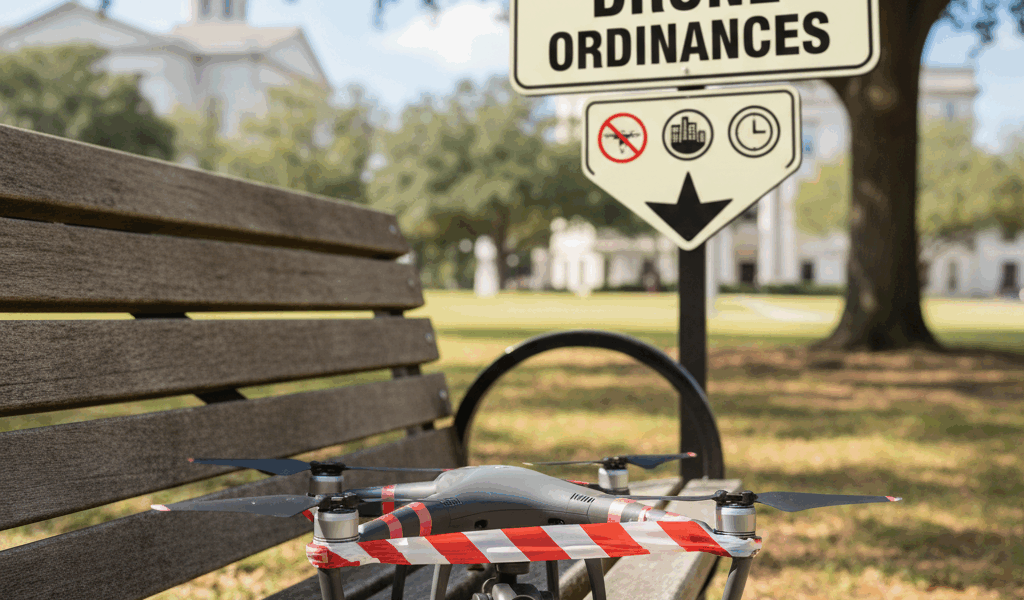

City Drone Bans: What’s Legal and What’s Not
City drone ordinances have gotten complicated with all the local bans and federal preemption arguments flying around. As someone who’s operated in dozens of cities with conflicting drone ordinances and even faced a citation that was later dismissed, I learned everything there is to know about navigating local restrictions. Today, I will share it all with you.
I got cited by a park ranger for flying over a city park. The ordinance said “no drone flights over park property.” I fought it on federal preemption grounds and won, but the process took months and cost me legal fees. That experience taught me the reality of city drone bans—legally questionable, but practically enforceable until you challenge them.
The Legal Framework: Federal vs Local Authority
Probably should have led with this section, honestly. The Federal Aviation Administration maintains exclusive jurisdiction over navigable airspace in the United States under the Federal Aviation Act of 1958 and subsequent legislation. However, hundreds of cities have enacted local ordinances that appear to regulate drone flights, creating legal ambiguity that pilots must carefully navigate.
In 2015, the FAA issued a memorandum explicitly stating that local governments cannot regulate drone operations in the national airspace. The memo emphasized that “A consistent regulatory system for aircraft and use of airspace can only be achieved at the federal level.” Despite this clear federal position, local ordinances proliferate, and enforcement actions occasionally occur.
What Cities CAN Legitimately Regulate
While cities cannot regulate airspace or flight operations, they retain significant authority over ground-based concerns:
- Takeoff and landing locations: Cities own public parks, buildings, and right-of-ways, giving them authority to prohibit launching or landing drones from these properties
- Privacy protections: Local laws prohibiting harassment, voyeurism, or invasive surveillance apply equally to drones as to other technologies
- Trespass and property rights: Cities can prohibit takeoff from private property without owner permission
- General nuisance laws: Noise ordinances, public disturbance laws, and harassment statutes apply regardless of whether drones are involved
- Time, place, and manner restrictions: Cities can restrict where and when drones may take off or land from city property without regulating flight itself
The critical distinction is between regulating the use of drones in navigable airspace (exclusively federal) versus regulating the effects of drone operations on the ground (legitimate local concern). A city ordinance prohibiting takeoff from city parks is likely valid; an ordinance prohibiting flying over city parks invades federal airspace jurisdiction.
What Cities CANNOT Regulate
Local governments lack authority to enact regulations that:
- Restrict airspace access: Bans on flying over specific geographic areas based on altitude or flight path
- Impose operational requirements: Mandates for pilot certification, aircraft registration, or equipment beyond federal rules
- Set altitude limits: Maximum or minimum altitude restrictions within navigable airspace
- Create permit systems for flight: Requirements to obtain city approval before conducting drone operations
- Establish no-fly zones: Geographic restrictions based on airspace concerns rather than ground-based property rights
These restrictions fall squarely within federal jurisdiction. Cities attempting to regulate these aspects of drone operations create legally vulnerable ordinances subject to preemption challenges.
Common Local Restrictions: Analysis and Validity
Parks and Recreation Areas
Among the most common local drone restrictions are bans on drone operations in public parks. The legal validity depends entirely on how the ordinance is structured.
Valid approach: “It shall be unlawful to launch, land, or operate a drone from any city park property.”
This restriction addresses the city’s property management authority without attempting to regulate airspace. You cannot use city-owned land as a launch point without permission.
Invalid approach: “It shall be unlawful to fly a drone over any city park at any altitude.”
This restriction attempts to regulate navigable airspace, clearly within federal jurisdiction. Such ordinances are vulnerable to preemption challenges.
Practical reality: Many city park bans use the invalid formulation but remain unenforced. However, pilots should not assume lack of enforcement equals legal authority. If challenged, courts may side with federal preemption, but the pilot still faces enforcement action, legal fees, and potential equipment confiscation.
Public Events and Gatherings
Cities frequently prohibit drones at parades, festivals, concerts, and sporting events. These restrictions aim to address legitimate public safety concerns about crowded gatherings.
Legal analysis is complex:
- Cities can prohibit takeoff from event grounds they control or permit
- Cities can enforce generally applicable crowd control and public safety laws
- Cities arguably cannot prohibit flying over events in navigable airspace
- FAA regulations already prohibit flying over people without waivers (Part 107.39)
In practice, flying over public events creates multiple legal risks even if local bans are technically invalid. Federal regulations, privacy concerns, and public safety considerations make such operations legally and ethically problematic regardless of local ordinance validity.
Government Buildings and Facilities
Local ordinances often restrict drone operations near city halls, police stations, courthouses, and other government facilities. These restrictions sit in a legal gray area.
Cities argue they have legitimate security concerns and property management authority over their facilities. The FAA has generally not challenged such restrictions when limited to takeoff and landing prohibitions or narrow security perimeters around the buildings themselves.
However, broad no-fly zones extending hundreds of feet from government buildings clearly implicate airspace management. Several cities have faced legal challenges to such expansive restrictions, with mixed results depending on how courts balance security concerns against federal preemption.
Schools and Educational Facilities
Restrictions on drone operations near schools respond to understandable concerns about child safety and privacy. Most states have laws restricting drone photography of children without parental consent, and many cities add geographic restrictions around school property.
Legal validity follows the same pattern as parks:
- Cities can prohibit takeoff from school property without permission
- Cities can enforce privacy laws protecting children
- Cities likely cannot create airspace-based no-fly zones around schools
However, practical and ethical considerations should govern pilot behavior regardless of legal technicalities. Flying near schools creates privacy concerns, frightens children and parents, and generates negative publicity for the drone community. Legal or not, avoid school operations unless specifically authorized.
That’s what makes local drone politics endearing to us commercial pilots—even when you’re legally right, you can still be practically wrong if the operation damages community relations.
Airports and Heliports
Many cities prohibit drone operations within specified distances of airports, typically 5 miles or more. These restrictions appear to address legitimate aviation safety concerns but clearly implicate airspace management—exclusively federal territory.
Federal law already requires authorization before flying in controlled airspace near airports through the LAANC system. City ordinances adding additional restrictions conflict with federal authority and risk creating a patchwork of incompatible requirements.
The FAA has stated repeatedly that local governments cannot regulate airspace near airports. However, cities continue enacting such ordinances, and pilots occasionally face enforcement actions despite arguably operating in compliance with federal rules.
Permit Requirements for Commercial Filming
Many cities require permits for commercial filming on public property, and some extend these requirements to drone operations. The legal status of such requirements depends on specific implementation.
Valid Permit Requirements
Cities can require permits for:
- Use of public property: Permits for occupying sidewalks, parks, or other public areas for production equipment and crews
- Traffic management: Coordination with police for road closures or traffic control
- Insurance requirements: Proof of liability coverage for commercial operations on city property
- Noise and disruption mitigation: Conditions addressing impacts on neighbors and businesses
These requirements address legitimate municipal concerns about ground-based activities and property management.
Invalid Permit Requirements
Cities cannot require permits that:
- Condition permission on city approval of flight operations or airspace use
- Allow cities to deny permits based on objections to the content being filmed
- Establish standards for pilot qualifications beyond federal requirements
- Create indefinite waiting periods or subjective approval processes
Such requirements implicate both federal aviation preemption and First Amendment concerns about government control of speech and press activities.
Practical Approach to Permit Compliance
Even when legal validity is questionable, commercial drone operators often choose to apply for local permits as a pragmatic business decision. Benefits include:
- Reduced risk of mid-shoot enforcement actions
- Better relationships with local officials for future projects
- Liability protection through documented approval process
- Professional reputation management
However, pilots should understand they are complying voluntarily, not because cities have legal authority to require such permits for airspace operations.
How to Research Local Laws Before Flying
Thorough research before operations helps avoid conflicts with local authorities:
Step 1: Check Municipal Codes
Most cities publish municipal codes online. Search for:
- “Unmanned aircraft” or “drone” in the code
- Park and recreation regulations
- Public property use restrictions
- Privacy and surveillance ordinances
Resources include Municode.com, which hosts codes for thousands of cities, and city official websites.
Step 2: Contact City Attorneys or Aviation Liaisons
Many larger cities have designated contacts for drone-related questions. Contact city attorney offices or aviation liaisons to clarify:
- Whether drone-specific ordinances exist
- City interpretation of existing regulations
- Permit requirements for commercial operations
- Enforcement priorities and typical responses
Document these conversations with dates, names, and specific guidance provided.
Step 3: Review State Preemption Laws
Several states have enacted preemption laws prohibiting local drone regulations that conflict with state or federal law. Check whether your operating location is in a state with such protections.
Step 4: Consult Drone-Specific Databases
Organizations like the National League of Cities and legal firms specializing in drone law maintain databases of local ordinances. While not exhaustive, these provide valuable starting points for research.
Step 5: Evaluate Practical Risk
Beyond legal analysis, consider practical enforcement risk:
- How actively does the city enforce drone ordinances?
- Have other pilots reported issues in this location?
- What are the potential consequences (fines, equipment confiscation, criminal charges)?
- Does the planned operation justify the risk?
Challenging Illegal Local Bans
When local ordinances clearly conflict with federal authority, pilots and advocacy organizations can challenge them through several mechanisms.
FAA Complaint Process
The FAA accepts complaints about local ordinances that conflict with federal aviation authority. Submit complaints through the FAA’s online system, including:
- Copy of the problematic ordinance
- Specific provisions that conflict with federal authority
- Impact on drone operations
- Request for FAA intervention
The FAA may contact the city to request modification or repeal of conflicting provisions. While the FAA cannot force compliance, cities often respond to federal pressure.
Legal Challenges
Pilots who face enforcement actions under invalid ordinances can defend on federal preemption grounds. Successful defenses establish precedent discouraging future enforcement.
Proactive legal challenges require standing (demonstrable harm from the ordinance) and resources for litigation. Drone advocacy organizations sometimes support test cases with strategic importance.
Advocacy and Education
Often the most effective approach is educating local officials about federal preemption. Many cities enact drone bans without understanding legal limitations on their authority.
Effective advocacy includes:
- Presenting FAA guidance on federal preemption
- Sharing examples of legally sound ordinances from other cities
- Explaining legitimate local concerns that can be addressed without conflicting with federal law
- Offering to work collaboratively on revised ordinances
Best Practices for Navigating Local Restrictions
Given the legal ambiguity and practical realities:
- Research thoroughly: Know local restrictions before operations, even if legally questionable
- Comply when practical: If complying with a local ordinance doesn’t compromise your mission, do so to avoid conflict
- Launch from private property: Operating from private property with owner permission avoids the strongest basis for local enforcement
- Document federal compliance: Maintain records showing compliance with all FAA regulations
- Maintain professional demeanor: If confronted by local officials, remain calm and professional
- Understand your rights: Know the legal basis for federal preemption, but pick your battles carefully
- Get legal advice: For high-stakes operations or enforcement actions, consult attorneys specializing in aviation law
- Support advocacy: Engage with organizations working to educate local governments and establish clear legal standards
Conclusion
The relationship between city drone bans and FAA authority remains legally unsettled. While federal preemption doctrine clearly limits local authority over airspace operations, hundreds of cities continue enforcing arguably invalid restrictions. Pilots must balance legal principles against practical realities, conducting thorough research, exercising good judgment, and maintaining professional relationships with local authorities. As case law develops and the FAA continues clarifying federal preemption, expect gradual movement toward legally sound local ordinances that address legitimate municipal concerns without improperly regulating navigable airspace.