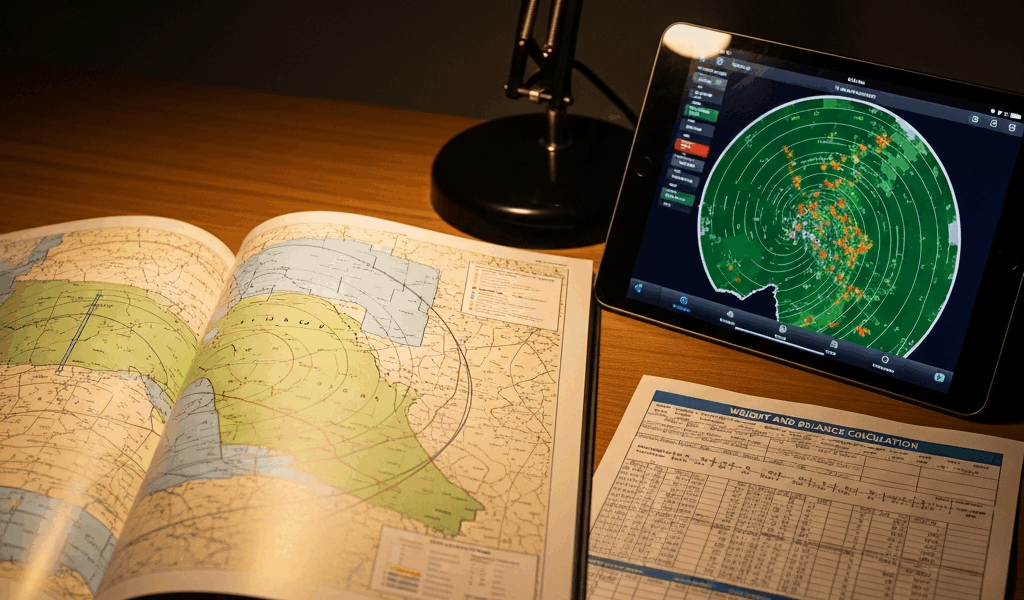
FAA Part 107 prep has gotten complicated with all the generic, one-size-fits-all noise flying around — and it’s costing people real points.
As someone who failed the Part 107 knowledge test the first time around, I learned everything there is to know about where the actual score bleeds out. Today, I will share it all with you.
I scored a 67 on my first attempt. Three points short. Brutal. What made it worse was realizing afterward that I’d spent the bulk of my study time on sections the FAA barely weights. The stuff I blanked on? Three topic areas that together account for 40 percent of the exam. Nobody told me that going in.
Frustrated by a ten-day retest window and a highlighted mess of study materials, I dug into the FAA’s own topic weighting data — something most prep courses don’t even mention exists — armed myself with a sectional chart, and walked out with an 87. Not because I got smarter. Because I stopped studying the wrong things.
If you’re staring at a 72 on a practice test wondering where the wheels fell off, you’re probably losing points in the same three places everyone else does. Here’s the breakdown — and the actual fixes.
The Sections Most People Fail On
Probably should have opened with this section, honestly.
The FAA buries its knowledge test topic weighting inside the Airman Knowledge Test Question Bank. Most people never find it. But what is this document, exactly? In essence, it’s the official blueprint of how exam points are distributed across subjects. But it’s much more than that — it’s the single most useful thing you can read before you open a study guide.
Here’s what the distribution actually looks like. Three areas eat 40 percent of your total score:
- Airspace classification and sectional chart reading (12 percent)
- Weather minimums and METAR interpretation (14 percent)
- Aircraft performance, weight and balance, and density altitude (14 percent)
Meanwhile, most people pour 60 percent of their energy into regulations and operating rules. That section? Eighteen percent of the test. Do the math on that trade-off.
Finding the official breakdown would have saved me roughly ten hours. Don’t make my mistake.
There’s a second failure pattern worth naming. Visual learners hit a wall on questions that demand reading and decoding structured data — sectional charts, METARs, loading charts. Generic prep courses throw practice questions at you. They rarely teach a systematic decoding method. So under test pressure, people guess. Wrong answers stack up fast.
So, without further ado, let’s dive in.
How to Stop Guessing on Sectional Charts
Sectional charts are dense. Color coding, overlays, boundary lines, symbol clusters — it’s a lot hitting you at once. Under time pressure, the brain skips steps and picks the answer that “feels right.” That’s what makes chart questions so dangerous to visual learners who haven’t built a deliberate decoding habit.
Three specific traps show up constantly:
Class D Shelf Boundaries
Class D airspace extends 5 nautical miles from the airport reference point. But it has a shelf — typically 2,000 feet AGL, sometimes higher depending on the airport. The exam loves scenarios where you’re sitting 3 nm out at 1,500 feet AGL asking “Can I operate here?” A lot of people say yes immediately. Wrong move.
The answer hinges on whether you’re inside or outside the shelf boundary, which the sectional marks with a dashed magenta line. Here’s the fix: ignore altitude first. Find the airport. Measure your distance from the center. Then — and only then — check your altitude against the shelf limit shown in the chart legend. Most wrong answers come from reversing that order.
Mode C Veil
The Mode C veil is the 30 nm ring around Class B airports requiring ADS-B or Mode C transponder equipment. On the sectional, it’s a thin magenta circle. Simple enough — until the test layers in specifics. “You’re 25 nm from a Class B airport at 8,000 feet. Mode C required?” No — you’re outside the 30 nm ring. But shift that to 28 nm and the answer flips. Or the question mentions altitude ceilings that vary by region. Read every number in the scenario. The trap is assuming all Mode C veils behave identically. They don’t.
Temporary Flight Restrictions
TFRs appear on sectionals as box outlines with associated NOTAMs. But the test rarely asks a simple “is there a TFR here?” question. It gives you a TFR active from surface to 5,000 feet AGL and puts you at 500 feet. Or a 3 nm radius TFR with your position at 4 nm. One wrong number in your mental math and the answer changes entirely.
Your Actual Study Move
Stop relying only on practice questions. Download the FAA’s free Sectional Chart Supplement — it’s on the FAA website, no account needed. When a chart-based question comes up in practice, pull the actual sectional and verify your answer against it. Print the chart. Mark it with a highlighter. The physical act of doing that encodes the information differently than reading a text explanation on a screen.
For Mode C veil and Class B questions specifically, build a one-page reference sheet listing the altitude limits and radii for every major Class B airport in your region. You can’t bring it into the testing center. But building it forces you to understand the underlying logic — and that logic is what the exam actually tests.
Reading METARs Without Overthinking Them
A METAR looks like a line of keyboard smashing the first time you see one. Most prep courses teach you to decode the entire string. Waste of time for Part 107. The exam tests exactly three elements: visibility, cloud ceiling height, and wind. That’s it. Everything else is noise you can ignore on test day.
Here’s a real example broken down:
KJFK 121851Z 09014G25KT 10SM FEW250 23/14 A2990 RMK AO2 SLP114 T02330139
Three things to extract for Part 107 purposes:
- 09014G25KT — Wind from 090 degrees at 14 knots, gusting to 25. Part 107 has no hard wind minimums written into the rule, but gusts above 35 knots are a practical no-go for most small UAS operations. A question might ask you to evaluate safety — that’s the relevant threshold.
- 10SM — Ten statute miles visibility. Part 107 requires a minimum of 3 statute miles. You’re clear here.
- FEW250 — Few clouds at 25,000 feet AGL. That’s irrelevant to your ceiling calculation. What matters is the lowest broken or overcast layer. If the METAR showed “OVC015” — overcast at 1,500 feet AGL — your maximum legal altitude under Part 107 would be 1,000 feet, since you need 500 feet of clearance below clouds.
The classic decoder mistake: people see “FEW250” and think they’ve found their ceiling. FEW and SCT (scattered) layers are not ceiling layers. Broken (BKN) and overcast (OVC) are what establish your ceiling. The exam throws both types into a single METAR and asks for the ceiling. Your answer is the lowest BKN or OVC layer — not the highest, not the most dramatic-looking number.
One more thing worth flagging: international METARs sometimes report visibility in meters rather than statute miles. You’ll also see “P6SM,” which means visibility greater than 6 statute miles. Recognize these variations so they don’t throw you mid-exam.
Your Study Move
Pull five real METARs from airports near you — aviationweather.gov has them, current and archived. Print them on paper. With a pen, underline only the three elements that matter for Part 107. Do it five separate times with five different METARs. You’ll internalize the visual pattern fast. On test day, you’ll scan a METAR, find your three numbers in under 20 seconds, and move on instead of burning two minutes second-guessing yourself.
Why Loading Charts Trip Up Visual Learners
Weight and balance problems and density altitude calculations feel completely disconnected from flying a drone. I almost skipped the entire section during my first study pass. That decision cost me four points on the actual exam. Don’t make my mistake.
Here’s the honest reason these questions are still on the Part 107 test: the knowledge exam is derived from the manned pilot test. The questions weren’t cleaned up for drone relevance. They’re there regardless. Together, weight/balance and density altitude account for roughly 7 percent of your score — roughly four to five questions. That’s the difference between passing and retesting.
A loading chart question looks roughly like this: “Aircraft empty weight 2,800 pounds. Pilot 180 pounds. Passenger 210 pounds. Fuel 40 gallons. Using the loading chart provided, is the aircraft within weight and balance limits?”
The chart gives you two axes — weight and center of gravity (CG). You plot a point. Inside the green envelope, you’re legal. Outside it, you’re not.
The systematic approach: add total weight first. 2,800 + 180 + 210 + (40 gallons × 6 pounds per gallon) = 3,430 pounds. Then, using the arm distances from the chart legend, calculate the moment for each item. Moment equals weight multiplied by arm distance. Sum all moments. Divide total moment by total weight to get your CG location. Plot CG against weight on the chart.
The trap is panic. People see the math, assume it’s irrelevant to their drone certification, skip the practice, and then freeze when the question appears. The sequence itself isn’t complicated — it just needs to be familiar before you sit down.
Your Study Move
Work through three loading chart problems on paper, showing every step. Don’t use a calculator on the first one — feel the arithmetic by hand, even if it’s slow. When you encounter a loading chart question on the actual exam, your brain recognizes the sequence and runs through it without locking up.
For density altitude, the concept is straightforward: hot, high, and humid equals thinner air and degraded aircraft performance. The exam gives you temperature, pressure altitude, sometimes dew point. The FAA provides a density altitude chart that handles the calculation for you. Print it, understand how to read it, then move on. This isn’t where you want to spend ten hours.
A Realistic Study Schedule for the Last Two Weeks
Fourteen days. Here’s what actually works — at least if you want to walk out with a score well above 70.
Days 1–3: Diagnosis
Take a full-length CATS practice exam under timed conditions. No notes. No pausing to look things up. Score it honestly. Write down the three topics where you dropped the most points. Those topics become your entire priority for the next phase. Everything else is secondary.
Days 4–7: Deep Work on Weak Areas
The FAA Airman Knowledge Test Question Bank is free and searchable by topic. Use it. Pull questions specifically from your weak areas and work through them — not just reading explanations, actually working the problems. For chart questions, open the actual sectional. For weather questions, decode real METARs from aviationweather.gov. For loading charts, do the arithmetic on paper.
Pilot Institute and King Schools both have solid video instruction. I’m apparently a visual learner and King Schools works well for me while text-only explanations never quite stuck. Watch only videos covering your weak topics. Skip anything you’ve already demonstrated competence in — that’s not where your score is hiding.
Days 8–11: Mixed Practice
Take a second full-length practice exam. Note the improvement — or lack of it. Then mix your daily sessions: 30 minutes on your strongest topic to build confidence, 45 minutes on your weakest to keep closing the gap. That rhythm prevents the burnout that comes from drilling nothing but hard material for days straight.
Days 12–13: Final Review and Test Conditions
Third full-length practice exam. After scoring it, review only the wrong answers — don’t re-read everything. Spend two hours the night before the real exam going over your one-page reference sheets: the chart summary, the METAR decoding pattern, the loading chart sequence. Then stop. Genuinely stop. Your brain consolidates during sleep, not during a fourth hour of cramming.
Day 14: Test Day
Bring a government-issued ID, your test registration confirmation, and a calculator if the testing center permits one — call ahead, since policies vary by location. The exam is 60 questions with a 2-hour, 15-minute window. Passing score is 70 percent, meaning you need 42 correct answers. The interface lets you flag questions and return to them, so use that feature instead of burning time staring at something you’re unsure about.
One last honest thing: I spent hours memorizing regulation text word-for-word. That was a waste. The exam doesn’t quote regulations back at you and ask for exact language. It tests whether you understand what a rule is actually trying to accomplish. Read for comprehension. Understand the intent. That’s what makes Part 107 study endearing to people who approach it right — it’s genuinely testing whether you can think, not whether you can memorize.
Use this approach and you won’t just pass. You’ll pass with room to spare.




Stay in the loop
Get the latest dronefaaregulations updates delivered to your inbox.