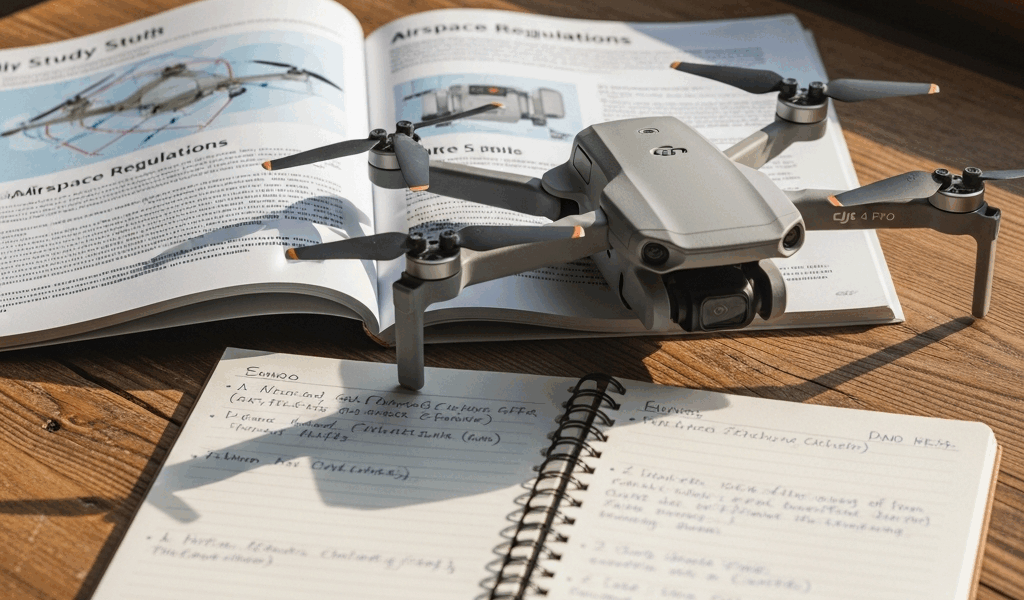
Why DJI Mini 4 Pro Questions Show Up on the Part 107 Exam
I’ve been coaching people through their FAA Part 107 remote pilot certification for three years, and here’s what jumps out immediately: examiners absolutely love throwing real-world drone models into their test scenarios. The DJI Mini 4 Pro pops up constantly on the actual exam — and there’s a straightforward reason. It’s the most popular commercial sub-250g drone on the market right now. When the FAA writes test questions, they use equipment people actually fly.
So here’s what actually matters: the Mini 4 Pro weighs exactly 249 grams, sits just under that magical 250g threshold that triggers completely different regulatory requirements, and has a 15-kilometer maximum transmission range. That transmission range means absolutely nothing if you break visual line of sight rules — it’s basically irrelevant. The exam tests whether you truly understand how the drone’s specifications interact with your actual operational limitations. A question might ask whether the Mini 4 Pro’s range allows you to fly beyond VLOS in Class D airspace. The answer is no, regardless of range, because Part 107 requires visual contact at all times. Understanding these distinctions? That’s what separates people who pass from those who don’t.
5 Real Exam Scenarios About DJI Mini 4 Pro Weight and Registration
Question 1: A remote pilot plans to operate a DJI Mini 4 Pro (249g) for commercial aerial photography. The pilot is not part of a Part 107 certificate holder’s operation. Which statement is correct?
- A) The pilot must register the aircraft with the FAA because it exceeds 100g
- B) The pilot must hold a Part 107 certificate to operate commercially, regardless of weight
- C) The pilot may operate without a Part 107 certificate under Part 107’s small UAS exemptions
- D) The pilot must register the aircraft and obtain a Part 107 certificate
Correct Answer: B
Any commercial operation requires a Part 107 remote pilot certificate — even with sub-250g aircraft like the Mini 4 Pro. That 250g weight threshold only determines certain exemptions and operational rules. It doesn’t eliminate the certification requirement entirely. This is where I see test-takers stumble most often. They think the Mini 4 Pro’s light weight means fewer rules apply across the board, but commercial flight always demands proper certification. Always.
Question 2: A DJI Mini 4 Pro operator is flying recreationally under Part 101 rules (not Part 107). Which registration requirement applies?
- A) No registration required because the drone is under 250g
- B) Registration required only if the drone weighs more than 250g
- C) Registration required if the aircraft weighs more than 55 pounds
- D) Registration always required for any UAS operation
Correct Answer: A
This trips up a lot of people, honestly. Under Part 101 recreational rules, any aircraft under 55 pounds doesn’t need FAA registration. Since the Mini 4 Pro is 249 grams — well, you do the math — it’s exempt. But here’s the catch: the moment you operate commercially under Part 107, registration and certification apply regardless of weight. That weight advantage disappears completely.
Question 3: A Part 107 remote pilot is preparing to fly a DJI Mini 4 Pro in an area with moderate wind gusts. What should the pilot reference to determine if flight conditions are acceptable?
- A) The DJI Mini 4 Pro maximum transmission range specification
- B) The aircraft’s maximum wind resistance rating in the manufacturer’s documentation
- C) Federal Aviation Regulation Part 107 wind speed limits
- D) Local airport wind speed advisories only
Correct Answer: B
Part 107 doesn’t specify wind limits — that decision lands on your shoulders based on what your specific aircraft can actually handle. The DJI Mini 4 Pro can handle wind up to roughly 10–12 m/s (about 22–27 mph), but you verify this in DJI’s official specs, not in FAA regulations. The FAA manual won’t tell you this. This is a practical question that tests whether you actually know your equipment inside and out.
Question 4: During a pre-flight inspection of a DJI Mini 4 Pro, a pilot discovers one propeller has a small crack. The pilot plans to seal it with epoxy and fly. Is this acceptable under Part 107?
- A) Yes, because the drone weighs under 250g and minor repairs are acceptable
- B) No, the aircraft should not be flown and the propeller should be replaced
- C) Yes, if the pilot conducts a test flight first to verify airworthiness
- D) No, but only if the crack is longer than 1 centimeter
Correct Answer: B
Part 107 requires you to conduct a preflight inspection and only fly if the aircraft is in a condition for safe operation. A cracked propeller fails that test, full stop. Repair attempts with epoxy don’t constitute proper maintenance — that’s just asking for failure at 300 feet. Replace it.
Question 5: A remote pilot owns both a DJI Mini 4 Pro and a larger Matrice 300 for different clients. If the pilot operates both under one Part 107 certificate, which statement is true?
- A) The Part 107 certificate applies to the larger aircraft only
- B) The certificate applies to both aircraft without restriction
- C) The pilot needs separate certificates for each aircraft type
- D) The certificate applies to both, but Mini 4 Pro operations have different limitations
Correct Answer: B
A Part 107 remote pilot certificate covers all UAS operations under Part 107 rules, regardless of aircraft type or weight. However — and this matters — operational limitations still apply based on each aircraft’s actual specifications. The Mini 4 Pro’s lighter weight may allow operations in some scenarios where the heavier Matrice 300 wouldn’t be permitted, depending on the specific airspace and mission parameters.
Part 107 Questions on Mini 4 Pro Altitude and Airspace Limits
Question 6: A DJI Mini 4 Pro pilot is operating at 300 feet AGL in Class D airspace near a controlled airport. The pilot has not received ATC clearance. Is this legal?
- A) Yes, because the drone is under 250g
- B) No, Part 107 requires ATC clearance for any operation in Class D airspace
- C) Yes, if the pilot maintains visual line of sight
- D) No, because 300 feet exceeds the 200-foot AGL limit
Correct Answer: B
Class D airspace requires ATC clearance regardless of the aircraft’s weight or Part 107 status. A sub-250g drone in Class D is not a free pass — that’s a common misconception. The weight advantage only applies to certain operational rules, not airspace restrictions. You still need clearance.
Question 7: A Mini 4 Pro pilot is flying at 180 feet AGL with a maximum transmission range of 15 kilometers displayed on the controller. The pilot loses visual contact with the aircraft at approximately 500 meters away. What violation has occurred?
- A) No violation; the aircraft is within transmission range
- B) VLOS violation; Part 107 requires visual line of sight at all times
- C) Altitude violation; the aircraft should be below 100 feet in populated areas
- D) No violation if the pilot re-establishes visual contact within 30 seconds
Correct Answer: B
This is the critical distinction I emphasize to everyone studying — seriously, I repeat this constantly. Transmission range and visual line of sight are completely separate requirements. They operate in different regulatory universes. Flying at 500 meters without visual contact violates Part 107, full stop. The Mini 4 Pro’s 15-kilometer range is irrelevant to this violation. Doesn’t matter. At all.
Question 8: A Mini 4 Pro is operating in Class B airspace under a Part 107 waiver. What altitude limitations apply?
- A) 400 feet AGL maximum, as specified in the standard Part 107 rules
- B) The altitude limits specified in the waiver itself
- C) No altitude limit, because the waiver overrides Part 107
- D) 200 feet AGL maximum in Class B airspace
Correct Answer: B
A waiver isn’t blanket permission to do whatever you want. Each waiver specifies exactly which rules are waived and what conditions replace them. The conditions in your specific waiver document — that’s what controls. Not standard Part 107 rules, not what some other pilot’s waiver said. Your waiver.
Question 9: Before operating a DJI Mini 4 Pro in an unfamiliar area, what is the primary resource a remote pilot should use to determine airspace classification and requirements?
- A) The drone manufacturer’s flight maps within the DJI app
- B) The FAA’s B4UFLY app or consulting current aeronautical charts
- C) Local airport advisory frequency
- D) Recent social media posts from other pilots in the area
Correct Answer: B
B4UFLY and official aeronautical charts are your authoritative sources — the ones the FAA actually maintains. The DJI app provides helpful reference information, sure, but it doesn’t replace the FAA’s official airspace data, which updates regularly and has legal teeth behind it.
Battery, Weather, and Operational Endurance Test Questions
Question 10: A remote pilot plans a commercial flight with a DJI Mini 4 Pro in calm conditions. The manufacturer specifies a maximum flight time of 31 minutes. What is the appropriate maximum flight duration the pilot should plan for this mission?
- A) 31 minutes, as the manufacturer specifies
- B) 25 minutes, to allow safety margin and return flight
- C) 15 minutes, as required by Part 107
- D) Whatever the pilot determines is safe for the specific mission
Correct Answer: D
Part 107 doesn’t dictate flight duration limits — that’s on you. The 31-minute spec assumes ideal conditions — no wind, no hovering, no aggressive maneuvering that burns battery faster. Real flights consume battery differently. A responsible pilot builds in safety margin, accounts for actual weather conditions, landing approach, and maintains reserve power just in case. The answer “whatever the pilot determines is safe” emphasizes personal judgment and situational awareness — which is what Part 107 actually tests.
Question 11: During a Mini 4 Pro flight, wind conditions increase unexpectedly from calm to sustained 15 mph gusts. What should the pilot do?
- A) Continue the flight because Part 107 has no wind restrictions
- B) Land the aircraft immediately and not resume flight
- C) Evaluate whether the aircraft can safely continue and land if not
- D) Contact ATC for wind guidance
Correct Answer: C
This tests real judgment — the kind you actually need in the field. The Mini 4 Pro can handle moderate wind, but “unexpectedly increasing” changes everything. That shifts your risk calculus entirely. The pilot must actively assess whether safety still exists and land if confidence decreases. Part 107 demands constant evaluation, not rigid rules followed blindly.
Question 12: A remote pilot conducts a thorough preflight checklist on a DJI Mini 4 Pro and discovers the battery is at 78% charge. The planned mission is 12 minutes of flight time in calm conditions. Should the pilot proceed?
- A) No, battery should be at 100% before any flight
- B) Yes, 78% charge provides sufficient margin for the 12-minute mission
- C) Only if ATC approves the flight plan
- D) Yes, if the pilot has a spare battery for extended operations
Correct Answer: B
78% charge gives you roughly 24 minutes of flight time in ideal conditions — way more than your 12-minute need. That’s adequate margin, honestly. You don’t need 100% for every flight, but you do need enough to complete the mission plus reserve capacity. This is practical knowledge that actually matters when you’re on a job.
How to Use These Questions in Your Study Plan
Probably should have opened with this section, honestly. Take these 12 questions, set a timer for 24 minutes (that’s the proportional time for 12 questions out of the 60-question, 120-minute actual exam), and answer them without notes. Write down your answers, then check them against my explanations. If you miss any — and you probably will the first time — read the corresponding FAA Part 107 study material and understand exactly why the correct answer is right. Don’t move forward until it clicks.
Register for your actual FAA knowledge test through the FAA FAOT system at faa.gov. The exam costs around $175 and you can schedule it at approved testing centers nationwide. Once you’ve worked through these questions and consistently score 15/15 (or better, 18/18 if you tackle extra practice materials), take full-length practice exams from reputable study platforms. Time yourself strictly — and I mean strictly. The real exam doesn’t feel rushed if you prepare methodically, but it absolutely will if you haven’t timed your studying.
Don’t memorize answers. That won’t work. Understand regulations instead. Every question I’ve included reflects actual test content because it tests real operational judgment that protects your safety, your clients’ safety, and public safety. That’s exactly why the FAA tests it.



Stay in the loop
Get the latest dronefaaregulations updates delivered to your inbox.