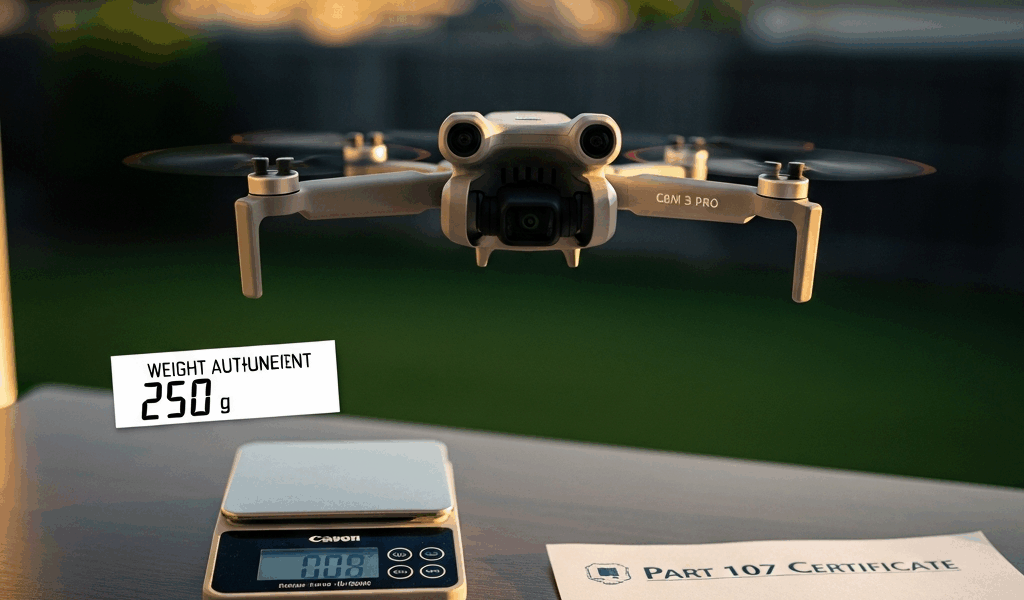
The Mini 3 Pro Is Under 250g — But That Does Not Mean No Rules
Drone regulation has gotten complicated with all the misinformation flying around. I get this question constantly: “My DJI Mini 3 Pro weighs 249 grams. Do I really need Part 107 certification?” As someone who picked up a Mini 2 years ago and assumed the weight exemption was basically a free pass, I learned everything there is to know about this subject the hard way. Today, I will share it all with you.
Here’s the truth. The FAA’s 250-gram threshold determines exactly one thing: whether you need to register your drone. Not insurance. Not airspace rules. Not commercial flight permissions. Just registration. Full stop.
The Mini 3 Pro sits under that magic number, so you don’t register it the way you would a Phantom 4 Pro or an Air 3. That’s the entire regulatory benefit of sub-250g drones — nothing more. I assumed otherwise. I was wrong. Flew real estate jobs without certification and spent three weeks quietly terrified about it before getting my Part 107 sorted out. Don’t make my mistake.
Everything else — flying commercially, operating in controlled airspace, flying near people, flying after dark — is governed by Part 107 regardless of weight. The FAA doesn’t care that your drone weighs 249 grams when you’re running it as a business tool. The weight exemption is real, but it’s narrower than the marketing makes it sound.
When Flying the Mini 3 Pro Requires a Part 107 Certificate
Commercial operation is the deciding factor. Compensation in any form — money, trade, barter, straight-up business benefit — means you need Part 107. Drone weight is irrelevant here. That’s what makes this rule trip up so many new pilots who just spent $759 on a Mini 3 Pro and assumed the sub-250g thing covered them.
So, without further ado, let’s dive in to the scenarios I encounter most:
- Real estate photography. You’re paid $200 to shoot aerial photos for a listing. That’s commercial. You need Part 107.
- Wedding videography. A couple pays you $1,500 for drone footage woven into their ceremony video. Commercial. Part 107 required.
- Construction progress documentation. A contractor hires you monthly to photograph site progress. Commercial. Part 107 required.
- Roof inspections. An insurance adjuster asks you to document storm damage and you bill for your time. Commercial. Part 107 required.
- Flying for your own business marketing. You own a restaurant and shoot aerial b-roll for Instagram. You’re not selling drone services directly — but you’re operating commercially. Part 107 is technically required, though enforcement in this gray zone varies wildly.
Recreational flying — you, your Mini 3 Pro, a Saturday morning with good light, zero dollars changing hands — needs no Part 107. You still can’t fly over people without permission. You still can’t buzz airports. Airspace rules apply. But certification isn’t required.
The genuinely confusing middle ground involves hobby flying that happens to benefit a business. A small YouTube channel with drone footage and light ad revenue. A local contractor who occasionally films his own jobs. The FAA’s stance gets murky here, and honestly I’ve seen different interpretations enforced depending on the inspector. When in doubt, Part 107 is the safe answer.
What Waivers Actually Apply to the Mini 3 Pro
But what is a Part 107 waiver? In essence, it’s permission to operate outside a specific rule. But it’s much more than that — it’s a formal application process, sometimes a lengthy one, and most Mini 3 Pro pilots will never need to file one.
Night Operations
Standard regs say no flying at night without a waiver. The Mini 3 Pro does have anti-collision lighting built in, and the FAA updated its framework to allow night flights under specific conditions when those lights are properly functioning. You’re technically still in waiver territory for traditional night operations — but DJI’s built-in lighting has created a cleaner pathway than older equipment offered. Most commercial operators I know still apply for the night waiver anyway. It costs time, roughly 90 days of processing, and some paperwork — but it removes ambiguity entirely.
Operations Over People
Standard Part 107 prohibits flying directly over people who aren’t part of your operation. Shooting a festival, a concert, a packed farmers market — you need a waiver. Real estate photography in a residential neighborhood is usually fine if you’re on private property with permission. That’s what makes this rule endearing to us commercial pilots — it’s actually reasonable once you understand the boundaries. Public crowds are the line.
Beyond Visual Line of Sight (BVLOS)
Flying the Mini 3 Pro past the point where you can visually track it requires a waiver. Pipeline inspection, agricultural surveying, long corridor mapping — all BVLOS territory. Most professional operators stay within visual line of sight anyway for safety and compliance reasons. The waiver process here is involved and approval rates are low without a strong operational safety case behind the application.
Probably should have opened with this section, honestly: most Mini 3 Pro operators never apply for waivers. Flying legally within Part 107 as written is sufficient for the vast majority of commercial work.
How to Get Part 107 Certified If You Need It
Part 107 certification means passing the Remote Pilot in Command exam at a Pearson Vue testing center. The exam costs $175. This is completely separate from the TRUST test — which is free, online, and required for recreational flyers. Ignore the TRUST test if you’re going commercial. It doesn’t prepare you for anything on the Part 107 exam.
The exam covers airspace classifications, regulations, weather interpretation, aircraft performance, loading, and emergency procedures. Study guides typically recommend 20 to 30 hours of prep time. I’m apparently someone who over-prepares, and spending closer to 40 hours worked for me while cramming the week before never works for material this technical. You want to understand the rules, not just pass the test.
After passing, you register with the FAA as a Remote Pilot in Command — no separate registration fee, it’s bundled into Part 107 status. Your certificate is valid for two years, then requires a recurrent knowledge test to maintain.
Study materials range widely. The FAA’s own Part 107 study guide is free and genuinely essential — don’t skip it. Third-party courses on Udemy or through drone-specific training companies run $30 to $150 and tend to organize the material in a more test-friendly format. I used one from a drone training company alongside the FAA guide. Both had value.
Mini 3 Pro Compliance Checklist Before Your Next Flight
- Determine your operation type: Recreational or commercial? Any compensation or business benefit at all — treat it as commercial. First, you should make this call honestly — at least if you want to avoid an enforcement headache later.
- Check registration requirements: Sub-250g means no FAA registration required. But commercial operation demands Part 107 certification regardless of what your drone weighs.
- Verify airspace authorization: Use LAANC — Low Altitude Authorization and Notification Capability — or contact ATC directly if you’re operating within controlled airspace near an airport. The B4UFLY app is useful here. Free, and updated regularly.
- Night flying: Ensure anti-collision lighting is functional and activated before takeoff. A night waiver might be the best option, as low-light commercial work requires legal clarity — that is because ambiguity around lighting compliance isn’t a fight worth having after the fact.
- Remote ID compliance: Federal Remote ID requirements are phasing in. Your Mini 3 Pro may need a Remote ID module depending on the enforcement timeline — check current FAA guidance, as this has shifted multiple times.
- Weather and airspace: Part 107 officially limits wind operations to 12 mph, though this specific number gets debated in pilot communities. Avoid clouds. Keep your aircraft in daylight visual range.
- Permission and people: Confirm you have authorization to fly at your location. Know where bystanders are — directly overhead without a waiver is a hard no.
The DJI Mini 3 Pro’s sub-250g weight removes one layer of bureaucracy. That was never a small thing — registration hassle and recurring fees aren’t trivial. But it doesn’t exempt you from flying smart, legally, or safely. Most commercial pilots I know treat the weight advantage as a lightweight operational edge, not a regulatory escape hatch. That framing will serve you a lot better long-term.



Stay in the loop
Get the latest dronefaaregulations updates delivered to your inbox.