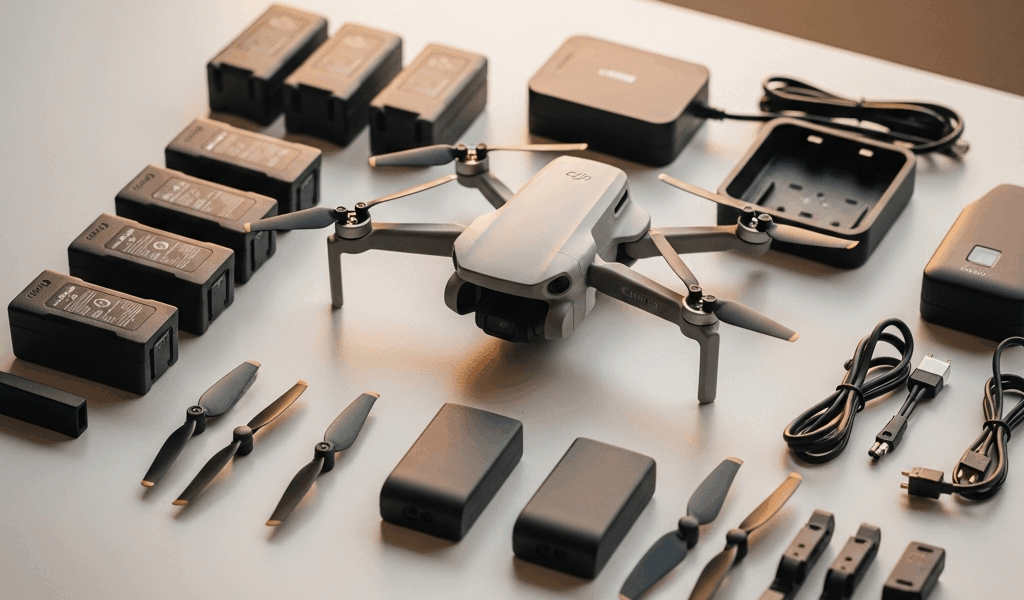
What Comes in the DJI Mini 4 Pro Fly More Combo
The DJI Mini 4 Pro Fly More Combo has gotten complicated with all the version confusion flying around. There are two variants out there in 2026, and mixing them up is the mistake most buyers make before they’ve even hit checkout.
The standard Fly More Combo includes:
- Two additional Intelligent Flight Batteries (three total with the aircraft)
- Two-Way Charging Hub (charges two batteries simultaneously via USB-C)
- Car Charger (12V)
- Battery to Power Bank Adapter
- ND Filter Set (ND4, ND8, ND16, ND32)
- RC-N1 Remote Controller (requires smartphone)
- Propeller Guards
- Spare Propellers and Low-Noise Propellers
The Fly More Combo Plus swaps the RC-N1 out for the RC 2 remote controller. That’s the whole difference. The RC 2 has a built-in 5.5-inch touchscreen — no phone mounting required, no fumbling with clamps. Everything else in the box stays identical.
Here’s the part that trips people up: the standard Mini 4 Pro already ships with an RC-N1 remote. So if you grab the standard Fly More Combo, you’re getting a second RC-N1. Some commercial pilots genuinely want that redundancy on shoots. Others just end up with a drawer full of remotes they never touch.
Fly More Combo vs Buying Accessories Separately
As someone who’s priced out drone kits for hobbyists and commercial crews alike, I learned everything there is to know about bundle math — mostly by doing it wrong the first time. Today, I will share it all with you. So, without further ado, let’s dive in.
Current retail pricing (verified January 2026):
- DJI Intelligent Flight Battery: $89 each
- Two-Way Charging Hub: $59
- Car Charger: $29
- ND Filter Set (4-pack): $49
- Battery to Power Bank Adapter: $15
- Spare propeller set: $18
- Low-noise propeller set: $18
- Propeller guards: $12
Buy everything individually: $369 total.
The standard Fly More Combo retails for $349. You save $20. That’s it. And honestly, that margin evaporates the moment one battery goes on sale anywhere.
The Fly More Combo Plus with the RC 2 runs $519. The RC 2 alone is $199. Add that to the standard combo math and you’d pay $548 buying piece by piece — so the Plus saves you roughly $29. Thin margins all around.
Probably should have opened with this section, honestly. During off-season sales, individual batteries drop to $75–$79. Snag two batteries and a charging hub separately on a sale weekend, and you’re already beating the combo price. That’s exactly why plenty of pilots skip the bundle entirely and go à la carte.
The real value isn’t the dollar savings. It’s having everything arrive in one shipment, configured and ready to go.
Which Version Makes Sense for Part 107 Pilots
Commercial drone work runs on different battery math than backyard flying. Regulations don’t mandate specific gear for Part 107 operators — but the job does.
Flying paid gigs — real estate walkthroughs, infrastructure inspections, agricultural surveys — means you need battery depth. The Mini 4 Pro posts 34 minutes of flight time under ideal conditions. Subtract headwinds, client delays, and repositioning flights between setups. Three batteries gets you roughly 90 usable minutes before you’re charging in the field. Barely enough for a serious afternoon shoot.
That’s what makes the Two-Way Charging Hub endearing to us commercial pilots. On a job site, you charge two batteries simultaneously while flying on the third. I watched a Part 107 operator on a corporate shoot sit idle for 45 minutes — single charger, one battery draining, client on the clock — because he skipped the hub. The $59 accessory essentially pays for itself on the first booking. Don’t make my mistake.
The included ND filters — ND4, ND8, ND16, ND32 — do their job for most commercial video work. They hold proper shutter speed in bright conditions without forcing you into high ISO territory. Honest take though: they’re starter-grade glass. Broadcast cinematographers usually replace them with PolarPro or similar third-party sets. For real estate walk-throughs and corporate content? Totally fine. For network television? They won’t cut it.
For an active Part 107 operator, the standard Fly More Combo is the call. A second RC-N1 is cheap insurance — if one remote fails mid-shoot, you’ve got a backup in the bag. Hobbyists don’t need that. Commercial pilots do.
RC 2 vs RC-N1 Controller and Why It Changes the Math
This is the detail that separates good purchasing decisions from buyer’s remorse.
But what is the RC-N1? In essence, it’s a traditional remote with a phone mount bolted on top. But it’s much more than that — it’s also your weak link. Your phone’s battery dies, your signal gets finicky, and suddenly you’re troubleshooting mid-flight. Lightweight. Widely compatible. Conditionally reliable.
The RC 2 is a different animal. Built-in 5.5-inch display, over 700 nits of brightness, readable in direct Arizona sunlight — I’m apparently sensitive to glare and the RC 2 works for me while the phone-mount setup never really did. No phone dependency. Dedicated flight screen. Adds some weight, costs $199 more.
Remote ID compliance — the FAA requirement broadcasting registration data from every drone — behaves differently on each controller. The RC 2 shows Remote ID status right on its built-in display. The RC-N1 buries it in the DJI Fly app on your phone. On a commercial job site, that difference matters. A Remote ID failure shows up instantly on the RC 2 screen. With the RC-N1, you might not catch it until you land and scroll through your phone.
For Part 107 operators, the RC 2 is a genuine workflow upgrade. No phone mount. No screen adjustments. No battery anxiety. For hobbyists flying weekend parks? The RC-N1 is perfectly fine and keeps $200 in your pocket.
Bottom Line on the Fly More Combo in 2026
Buy the standard Fly More Combo with RC-N1 if you’re flying commercially or planning to within the next year. Two-way charging hub, redundant controller, $349 — it makes sense for paid work.
Buy the Fly More Combo Plus with the RC 2 if you’re billing clients regularly and want a cleaner job site setup. The built-in screen changes how shoots actually run. Worth $519 if clients are writing checks.
Buy nothing extra if you’re a hobbyist. Seriously. The Mini 4 Pro alone is a complete package. Watch for a battery sale — they drop to $75 periodically — grab one, and you’re set for every weekend flight you’ll realistically take.
One more thing. Buy from B&H, Adorama, or DJI’s official store only. Gray market units occasionally ship with outdated Remote ID firmware — getting FAA compliance untangled from that is a genuine nightmare. The $20 or $30 you save from a sketchy third-party listing is not worth a regulatory headache on a job site.



Stay in the loop
Get the latest dronefaaregulations updates delivered to your inbox.