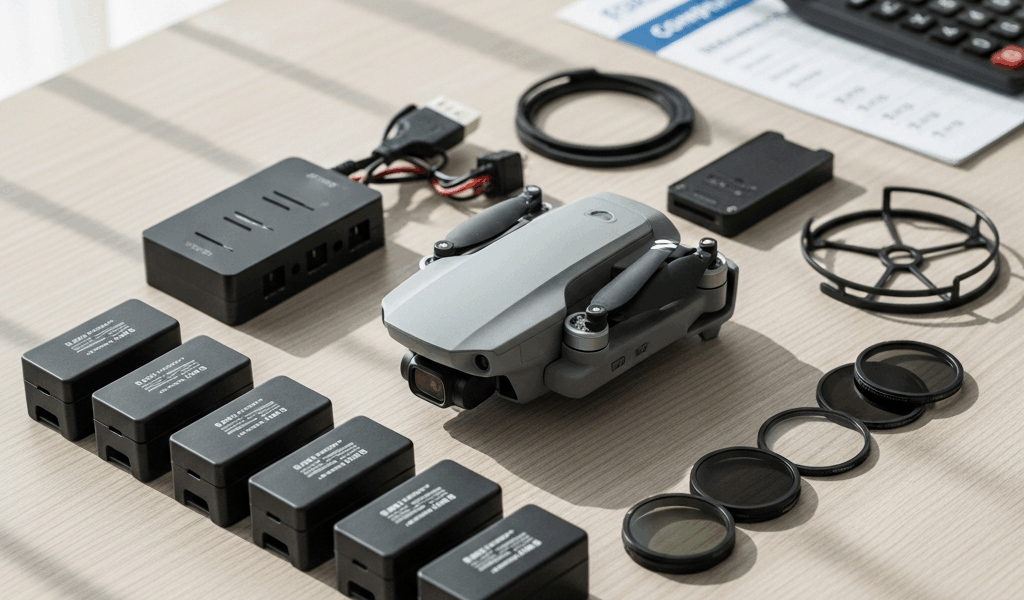
DJI Mini 3 Fly More Combo — Is It Worth Buying
This article includes affiliate links. We may earn a commission at no extra cost to you.
The DJI Mini 3 Fly More Combo question has gotten complicated with all the conflicting noise flying around pilot forums and Facebook groups. As someone who has been flying the Mini 3 for commercial work under Part 107 for about eighteen months, I learned everything there is to know about this purchase decision the hard way. Today, I will share it all with you.
Most advice out there lands in one of two useless camps: “buy everything DJI sells” or “the stock drone is fine.” Neither helps you. The real answer hinges on whether you’re a commercial operator, a weekend hobbyist, or something in between — and I’ve made enough mistakes here to save you from making the same ones.
What Comes in the DJI Mini 3 Fly More Combo
But what is the Fly More Combo, exactly? In essence, it’s a bundled package that adds batteries, charging gear, filters, and a bag on top of your base drone purchase. But it’s much more than that — it’s also where most buyer confusion begins, because DJI makes two Mini 3 variants and the contents aren’t identical across both.
Let me be specific. The DJI Mini 3 Fly More Combo includes:
- One DJI Mini 3 with the standard remote controller — not the DJI RC or RC-N1 variants
- Two additional Intelligent Flight Batteries, bringing your total to three
- One Two-Way Charging Hub that charges two batteries simultaneously
- One set of ND filters — ND4, ND8, ND16, ND64
- One shoulder bag designed specifically for the Mini 3
- One battery charging cable plus assorted accessories
The Mini 3 Pro version bundles nearly identically, though the included remote is still the standard model. Batteries are standard Intelligent Flight Batteries rated at 2250 mAh — not “Plus” batteries, which died off after the Mini 2 era. Flight time runs roughly 34 minutes maximum per charge under ideal conditions. Real-world flights net 25–28 minutes. Wind and payload eat into that fast.
The Two-Way Charging Hub is quietly the most valuable item in the box. Plug it into wall power, slot in two batteries, and both charge simultaneously in about 60–75 minutes. For commercial work, that changes everything. For casual weekend flying, it’s a genuine convenience — just not a necessity.
The ND filter set earns its keep only if you’re shooting video in bright sunlight and want that cinematic motion blur. Overcast conditions or indoor work? You probably won’t touch them for months. Don’t factor them heavily into your decision either way.
Fly More Combo vs Buying Accessories Separately
Probably should have opened with this section, honestly. Let’s run the actual numbers.
As of early 2024 — verify current prices on the DJI store before you buy, because they shift — here’s how the math breaks down:
- DJI Mini 3 standard package: $349
- Intelligent Flight Battery, single unit: $59 each — two additional batteries runs $118
- Two-Way Charging Hub: $49
- ND Filter Set, 4-pack: $19
- Shoulder Bag: $29
Buying everything à la carte: $564 total. The Fly More Combo retails at $469. Actual savings: $95. That’s roughly 17% off the piecemeal total — not massive, but real money.
There’s another angle here most people miss. The combo locks you into accessories DJI engineered specifically for this drone. No generic bag that barely fits. No third-party ND filters that vignette at the edges. That compatibility alone has saved me at least one ruined shoot.
One caveat worth flagging — I’m apparently someone who checks DJI’s sale page obsessively, and holiday pricing works for me while standard retail pricing never quite feels right. I’ve watched the standard drone drop to $279 and the combo slide to $399 during promotions. Don’t make my mistake of buying at full retail a week before Black Friday. Check the calendar. Check the store. Then decide.
Who Should Buy the Fly More Combo
Part 107 Commercial Pilots — Buy It
Flying commercially means burning through batteries. A typical real estate or inspection shoot involves three to five flights minimum. The combo’s three-battery setup plus dual charging hub lets you charge two packs while flying the third — dead time between jobs nearly disappears. Over a year of regular Part 107 work, you’d buy those batteries eventually anyway. Get them upfront, pocket the $95 savings. The math barely requires discussion.
Hobbyists and Weekend Flyers — Probably Skip It
Flying once or twice a month for fun? The single battery in the standard package handles that just fine. Charge it, fly, land. The extra batteries, hub, and bag become nice-to-haves rather than necessities. ND filters are genuinely useful for video work — but you can grab those separately later, once you’ve decided whether cinematic motion blur actually matters to your shooting style. Don’t pay upfront for gear you’re not sure you’ll use.
Travel Photographers — It Depends
Travel shooters have competing priorities pulling in opposite directions. The shoulder bag in the combo is well-made but bulky — not ideal for carry-on packing on international flights, where cubic inches matter. Extra batteries, though? Genuinely valuable when power outlets aren’t guaranteed. That’s what makes the combo endearing to us travel photographers despite the bag situation. My recommendation: buy the combo, and if the bag doesn’t survive contact with your packing system, resell it separately. The batteries and hub justify the price on their own.
FAA Registration and Remote ID Before You Fly
Before you even crack open the box — understand this. The Mini 3 weighs slightly over 249 grams. That one gram pushes it into mandatory FAA registration territory. Head to faa.gov/ufasdronezone, pay $5, spend ten minutes filling out the form. You’ll receive a registration number that must be physically labeled on the drone before your first flight.
Remote ID is built into the Mini 3 hardware. The FAA can identify your drone in the air without any external module. You’re compliant out of the box. No additional hardware, no extra cost, no workaround needed.
Even hobbyists register. This isn’t optional and it isn’t a suggestion. Do it first — before that first flight, before that first unboxing video, before anything.
Bottom Line — Is the Fly More Combo Worth It
Yes, for most buyers. So, without further ado, here’s the short version: the $95 savings are real, but the batteries and dual charging hub are the actual reason to buy. For Part 107 pilots, the combo is effectively mandatory. For casual hobbyists, it’s probably overkill unless you’re genuinely planning multiple flights per month. For travel photographers, those extra batteries solve a real, tangible problem — the bag is a solvable inconvenience.
Buy it if you’ll cycle through all three batteries within six months. Skip it if weeks pass between flights. And verify current pricing before you commit — DJI’s numbers move, holiday sales genuinely shift the calculus, and the $95 advantage can stretch or shrink depending on when you’re reading this.
Register the drone with the FAA regardless of which package you choose. That part isn’t optional. Then go fly.

Stay in the loop
Get the latest dronefaaregulations updates delivered to your inbox.